Humanoid robots just crossed from demos to production lines, and every unit that rolls off carries dozens of metal parts designed in a process that is still changing. Tesla’s Optimus V3 entered mass production in July–August 2026 — a Fremont line with one-million-unit annual capacity came ready on July 1, with Texas targeted at ten million long-term, large-scale production by end of 2026 and sales in 2027[1]; by August, V3 units were already working inside Tesla’s own car factories[2]. The machine itself reads like a metal AM wish list: 37 joints, 22-degree-of-freedom hands with ±0.02 mm precision, 1.72 m at a 1.2 m/s walk[1]. This article works through the manufacturing question the launch raises: which 3D printed robot parts make sense at hundred-thousand scale, which don’t, and what the ramp does to everyone’s supply chain.

The Scale Math: 37 Joints × 1,000,000 Units
Start with the arithmetic that changes everything. One Optimus-class robot carries 37 joint assemblies[1], each with housings, carriers, and interface structures in metal, plus the hand assemblies — 22 degrees of freedom each[1], meaning dozens of miniature structural parts per arm. At a million units a year, a single part number in the hand can exceed ten million pieces annually.
That volume is automotive territory, and automotive territory has ruthless process economics: die casting, metal injection molding (MIM), and extrusion eat AM alive on simple geometries at those counts. Anyone claiming “robots will be 3D printed” at that scale is not doing the math. The interesting question is narrower and more useful: where inside the robot — and around its production ramp — does metal AM still win?
Where 3D Printed Robot Parts Win at Volume
Four zones survive the volume math:
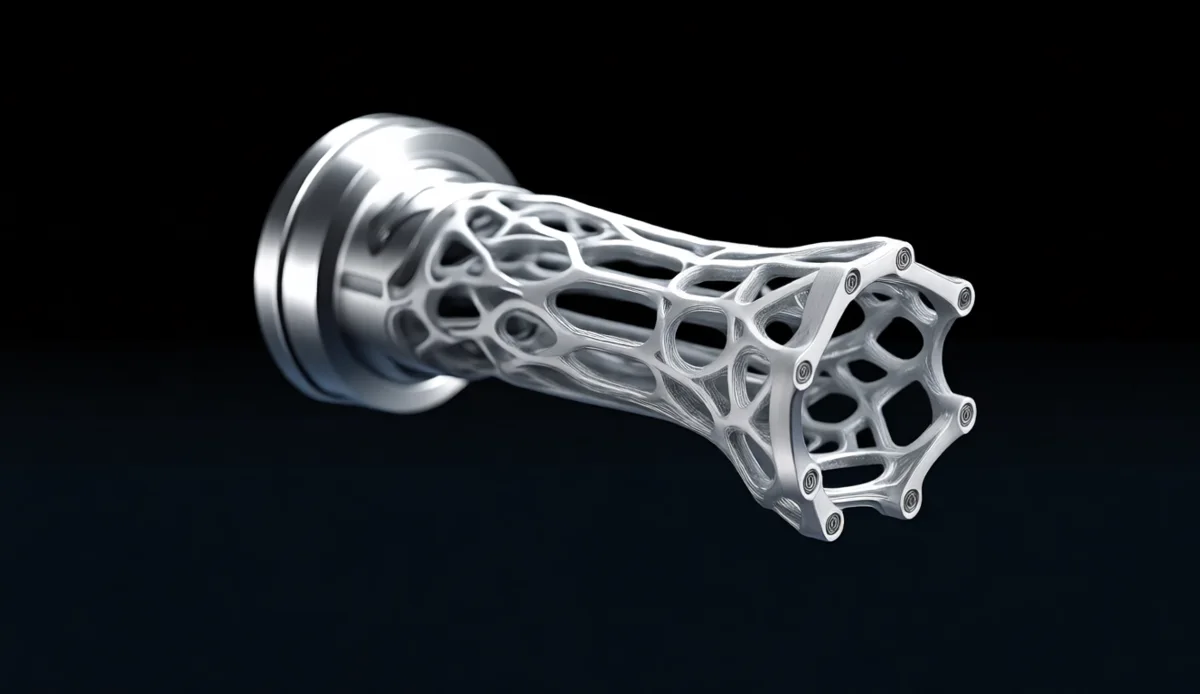
- Complexity-dense structural parts. Joint carriers that consolidate bearings seats, cable routing, and mounting interfaces into one topology-optimized body. The WRC-exhibited production data — shoulder brackets 46% lighter, torso frames 49% lighter via multi-scale lattices — is the proof of concept (covered part by part in our humanoid robot parts analysis). At volume, these parts stay printed when the consolidation deletes enough assembly labour to offset the per-piece premium.
- The hands. Twenty-two DOF in a human-sized hand means miniature, load-bearing, impossibly tight packages. Parts that small and that integrated are expensive to tool for casting and awkward to machine; printed small-batch production with tooling-free revisions fits the hand’s expected iteration rate.
- Ramp-phase parts. During a production ramp — and Musk’s own framing is that Optimus is “the hardest product to mass-produce,” with the S-curve just beginning — designs change monthly. Every revision to a cast part means new tooling and weeks of lead time; a printed part absorbs revisions at the speed of a CAD save. Even parts destined for casting later run printed through the ramp.
- The factory around the factory. End effectors, fixtures, grippers, and tooling for the robot production line itself — low-volume, high-urgency, geometry-custom. This is the quiet, immediate AM market every mass-production launch creates, and it starts before the product does.

Where AM Loses — Honestly
| Part class | At ~100k/yr | At 1M+/yr |
|---|---|---|
| Simple brackets, covers | AM competitive (no tooling) | Stamping/casting wins |
| Joint housings (complex, consolidated) | AM wins | AM wins if consolidation ratio holds |
| Hand micro-structures | AM wins | AM vs MIM — fight decided by tolerance |
| Shafts, bearings races, gears | Machining wins | Machining wins |
| Line tooling & fixtures | AM wins | AM wins |
| Battery/thermal structures | Case by case | Extrusion/casting mostly |
The tolerance column deserves the footnote: ±0.02 mm hand precision[1] is not an as-printed number in any powder-bed process — it is printed-near-net plus finishing (machining, grinding, or reaming) on the critical features. AM at this precision means hybrid process planning, and shops that pretend otherwise fail inspection. Our AM vs CNC cost analysis covers where the hybrid line sits economically.
Materials: What the Robot Actually Prints In
- AlSi10Mg aluminum for the lightweight structural family — brackets, carriers, lattice frames. The weight savings quoted from the WRC parts (46–56% across shoulder, torso, forearm) live here.
- 316L / 17-4PH stainless for joint internals, fastener interfaces, and wear-adjacent structures where stiffness and corrosion matter; the two alloys’ trade-offs are detailed in our 316L vs 17-4PH comparison.
- Titanium at the highest stress-density points — ankle and knee carriers on a 1.72 m biped see real impact loads.
- Tool steels (maraging class) not in the robot, but in the line tooling the ramp consumes.
Powder strategy follows the same logic as the aerospace ramps: one qualified powder lot policy per material, reuse cycles capped and documented, and oxygen/nitrogen content tracked per lot — because at hundred-thousand scale a single bad powder lot propagates into thousands of parts before anyone sees the first failure.
None of this is exotic — which is the point. A robot ramp does not need new materials; it needs existing LPBF materials at automotive consistency: powder lot traceability, per-build witness coupons, and statistical process control. The production playbook from a thousand printed rocket engines transfers directly — see our Rutherford at 1,000 analysis for what that discipline costs and buys.
The Supply-Chain Wave: What Ramp Means for AM Shops
A million-unit program does not print everything in-house, and the Chinese supply chain is already positioned: BLT and peers exhibited a full family of production-intent robot parts at WRC 2026, from 0.8 kg shoulder brackets to support-free 3.3 g finger motor mounts. The demand signature of a ramp is predictable:
- Tooling demand comes first — fixtures, jigs, end effectors, inspection aids — weeks before product parts move.
- Bridge production comes second — printed parts covering casting-tool lead times while designs freeze.
- Complexity-dense product parts come third — and they come with PPAP-style documentation: material certs, process qualification, first-article reports. Shops without that paperwork do not get the volume work; our 2026 standards guide maps what auditors will ask for.
- Spare parts come forever — a fleet in the field needs on-demand replacement geometry for a decade, the classic digital-inventory case.
| Ramp stage | Timing vs line start | AM work type | Qualification bar |
|---|---|---|---|
| 1. Line tooling | Months before | Fixtures, jigs, gauges, end effectors | Internal — fast |
| 2. Bridge production | Launch ± months | Printed parts covering casting tool lead times | Functional test |
| 3. Product parts | Post design-freeze | Complexity-dense joints, hand structures | Full PPAP-style dossier |
| 4. Field spares | Forever | On-demand replacement geometry, digital inventory | Cert-per-batch |
The qualification column is the business insight: stage 1 pays fast with minimal paperwork, stage 3 pays most but demands the dossier, and most shops position for stage 3 without ever winning stage 1. Enter the ramp where the bar matches your current documentation, and climb as the program does.
Common Misconceptions
“Mass-produced robots will be mostly 3D printed.” They will be mostly cast, stamped, and machined — with printed parts concentrated where complexity, iteration, or tooling economics favor them. The printed share is strategic, not volumetric.
“AM can’t hold robot tolerances.” Not as-printed at ±0.02 mm — but printed-near-net plus finishing hits it routinely. The question is never “can AM do tolerance,” it is “what hybrid process plan does the feature need.”
“The robot ramp doesn’t matter unless you win product parts.” Tooling, fixtures, and bridge production are real revenue arriving sooner, with lower qualification barriers. The shops that win product parts later are the ones already inside the ramp through its tooling.
“Robot programs pick one manufacturing route and stick to it.” Ramps run mixed routes deliberately — printed, cast, and machined versions of the same part can coexist for months while designs freeze and tooling lands. Suppliers who can quote the same part three ways stay relevant through all of it.
FAQ
When did Optimus V3 enter mass production?
July–August 2026: the Fremont line (one-million-unit annual capacity) was ready July 1, large-scale production targets end of 2026, sales begin 2027, and by August V3 units were working inside Tesla’s car factories.
Which robot parts are actually 3D printed?
Complexity-dense parts: topology-optimized joint carriers and structural frames (46–56% weight savings demonstrated at WRC), miniature hand structures, ramp-phase revisions, and the production line’s tooling and fixtures. Simple high-volume parts go to casting and stamping.
Can 3D printing hold the precision of a 22-DOF robot hand?
Yes, as a hybrid: printed near-net shape with machined or ground critical features. ±0.02 mm is a finishing tolerance, not an as-printed one — process planning, not printer marketing, decides the outcome.
What metals are used in printed robot parts?
AlSi10Mg for lightweight structures, 316L/17-4PH stainless for joint internals and interfaces, titanium for high-impact carriers (ankles, knees), and tool steels for the production line’s fixtures and dies.
Why does a production ramp favor additive manufacturing?
Because the design is still moving. Every revision to a tooled part costs weeks and tooling money; a printed part absorbs revisions at CAD speed. Even parts destined for casting run printed until the design freezes.
What should an AM shop do to serve robot programs?
Chase the sequence: line tooling first, bridge production second, product parts third — and arrive with the paperwork (material certs, process qualification, first-article reports) that automotive-scale auditing demands.
Is the 3D printed robot parts market realistic for a small or mid-size AM shop?
Yes, through the ramp sequence rather than headline product parts. Line tooling, bridge production, and field spares are fragmented, urgent, and geography-flexible demand that small shops win on responsiveness — provided basic material certification and first-article documentation are in place.
Are Chinese suppliers in this market?
Actively — production-intent robot part families were exhibited at WRC 2026, spanning large lattice frames down to support-free 3.3 g micro-parts, indicating the supply chain is tooling up ahead of the volume curve.
Conclusion: The Ramp Is the Opportunity
A million-unit humanoid program will not be printed — but a decisive share of its 3D printed robot parts demand (joints, hands, ramp revisions) plus the entire tooling ecosystem around its lines will be, and that is a real and near-term metal AM market with automotive-scale discipline requirements. The winners are shops that read the ramp sequence correctly (tooling → bridge → product → spares) and arrive with qualified processes and audit-ready documentation before the volume RFQs land. If your capability fits any stage of that sequence, bring your part family and volume curve to our RFQ page — we will tell you honestly which stage your process belongs in. For the applications overview, see our robotics and automation sector page.
References
- East Money Roadshow research note. “Optimus 是特斯拉研发的人形机器人,2026 年 7-8 月启动第三代 V3 量产” (Optimus V3: production start July–August 2026; Fremont and Texas line capacity; V3 specifications). eastmoney.com, July 10, 2026. Link (accessed September 2, 2026).
- Toutiao Tech. “特斯拉 8 月已启动 Optimus 机器人产线:V3 进厂造车,得州工厂将造 V4” (Tesla’s Optimus line running in August: V3 working in car factories; Texas to build V4). toutiao.com, August 2026. Link (accessed September 2, 2026).