
Metal 3D Printing for Humanoid Robots
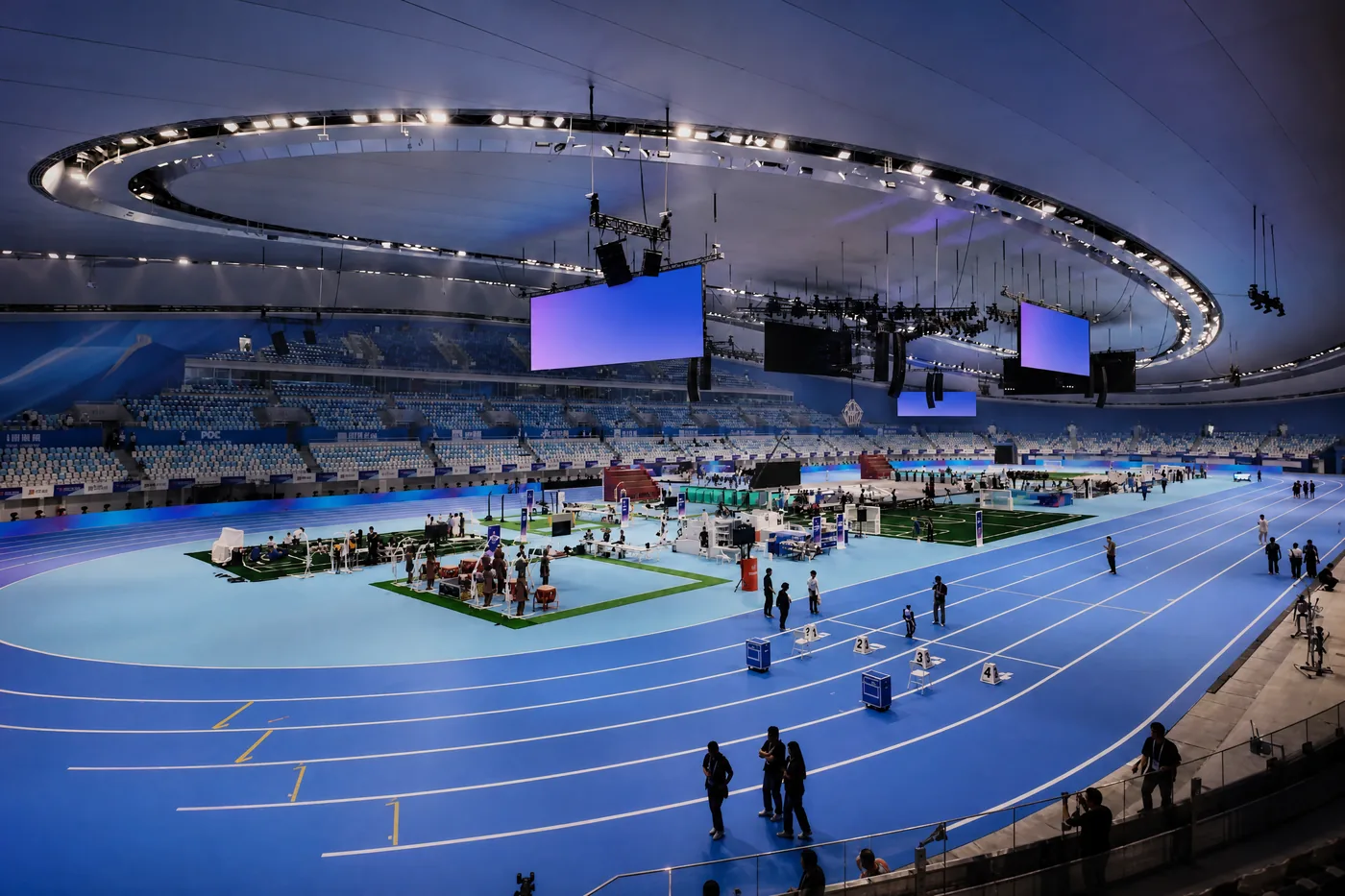
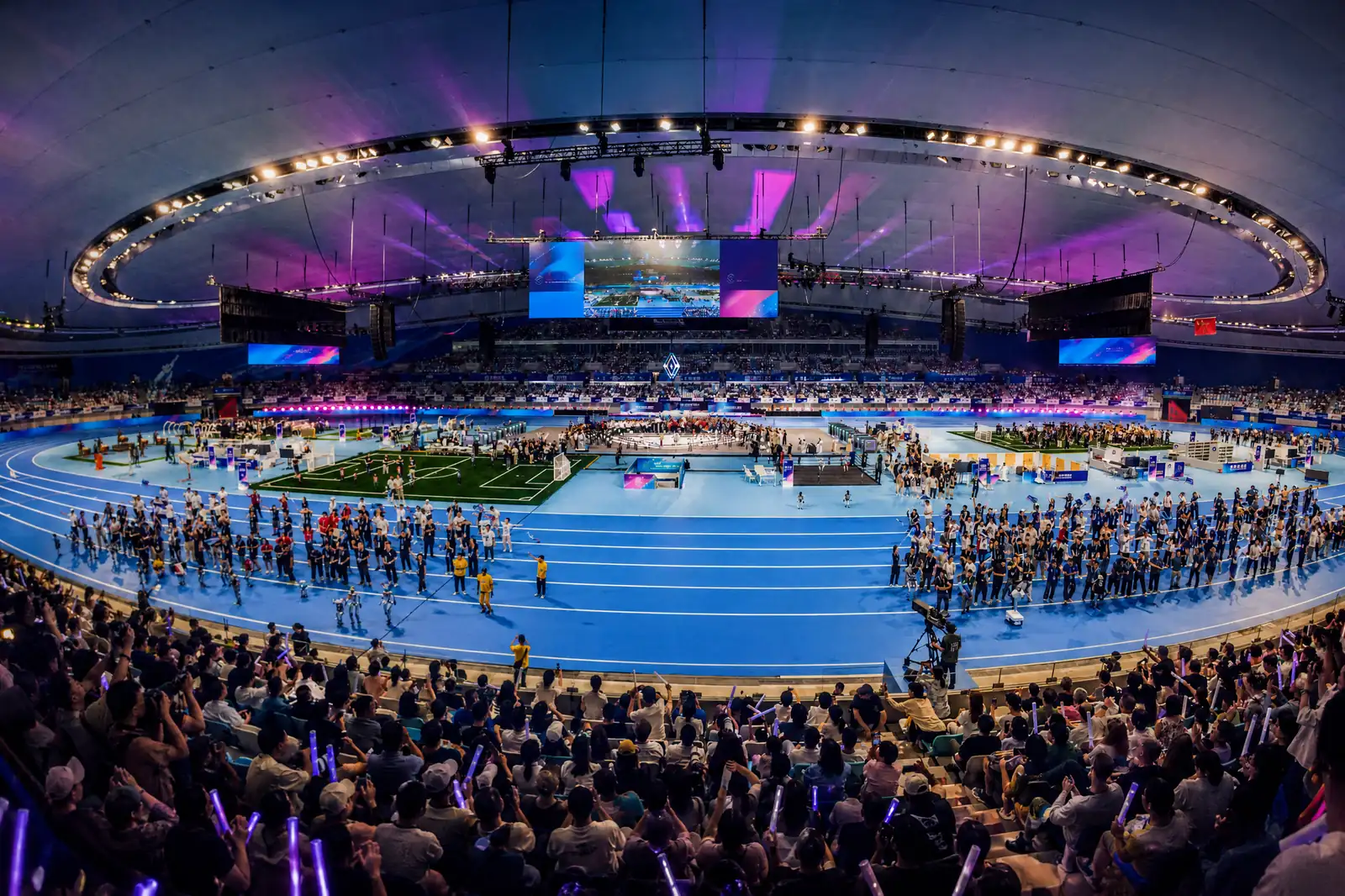
Metal 3D printing for humanoid robots is no longer a feasibility study — it is how this generation of competition and industrial humanoids gets its lightest, stiffest arms, legs and hands. At the 2026 World Humanoid Robot Games in Beijing (22–26 August), 2,056 robots from 16 countries contested 51 events; a TianGong Ultra ran 100 m in 9.39 s and cleared a 2.8843 m standing vertical jump.[8] Those numbers are only reachable with brutally low limb inertia, and that is a manufacturing problem.
By 3D Demiurge Engineering · Updated 23 Aug 2026 · 8 min read
What the 2026 Games reveal about robot mass
The Games are the clearest public stress test of high-DOF humanoids. Moving-link mass on a 6-DOF limb multiplies torque, energy draw and tracking lag at every joint. So weight is the competitive KPI, and it is exactly the metric metal AM attacks.[8]
Cutting mass is a manufacturing decision, not a motor decision
A 100 m in 9.39 s or a 2.88 m vertical jump is achieved by removing grams from the shins, thighs and arms — the segments that accelerate hardest. Cast and CNC parts carry that mass because their geometry has to be manufacturable. Metal AM does not.
Which humanoid robot parts are actually metal 3D printed
Public, verifiable cases cluster in three places: limb structure, the hands and wrists, and force-sensing joints. The most cited is the TianGong 3.0, whose upper-arm, wrist and leg-shell components are printed as single-piece parts in AlSi10Mg and titanium by AVIC Maite (中航迈特) on MT400M/MT650 LPBF machines, with topology-optimized hollowing, bionic lattices and conformal cooling channels.[1]
| Model / assembly | Component | Material | Process | Weight effect |
|---|---|---|---|---|
| TianGong 3.0 | upper arm, wrist, leg shell | AlSi10Mg + Ti | LPBF (MT400M/MT650) | parts → one; ≥280 MPa |
| BLT humanoid set | shoulder bracket, sternum, forearm, thigh, finger joints | Al + Ti + high-strength steel | PBF-LB/M, one furnace ~3 days | screw −85%, gear −65% |
| Farsoon dexterous hand | one-piece titanium finger segments | Ti-6Al-4V | LPBF, 20 µm layers | hollow + wiring channels |
| Hanbang lower limb | hip support, calf bone, leg shell | high-strength Al | SLM (HBD P400) | −40% each, strength held |
| BLT + Huaili sensors | six-axis force sensor (finger/wrist/ankle) | Ti / high-strength steel | metal AM, one-piece | wrist −20–30% |
BLT (Bright Laser Technologies) demonstrated a shoulder bracket, sternum, forearm, thigh and finger-joint set built with topology optimization and multi-scale design to fuse many separate components into one, printed in roughly three days on a BLT-S600.[2] On the sensing side, BLT and Huaili produce six-axis force sensors — an 8.5 mm fingertip sensor and a lighter wrist sensor — using metal AM for the load-bearing core.[3]
Dexterous hands are the growing edge
Farsoon (华曙高科) prints one-piece titanium finger segments with hollow cavities and internal routing channels, at 20 µm layers, ±0.05 mm and Ra 3.2 µm.[4] Hanbang (汉邦激光) shows the lower limb: a 111 g hip support (−40%), a 667 g calf bone (−40%, strength unchanged) and a 185 g leg shell (−40%) in high-strength aluminum.[5] The Games’ first-ever dedicated dexterous-hand event — weighing, tweezing beans, opening caps — is the venue that makes these numbers matter.
Why topology optimization + DfAM delivers the weight savings
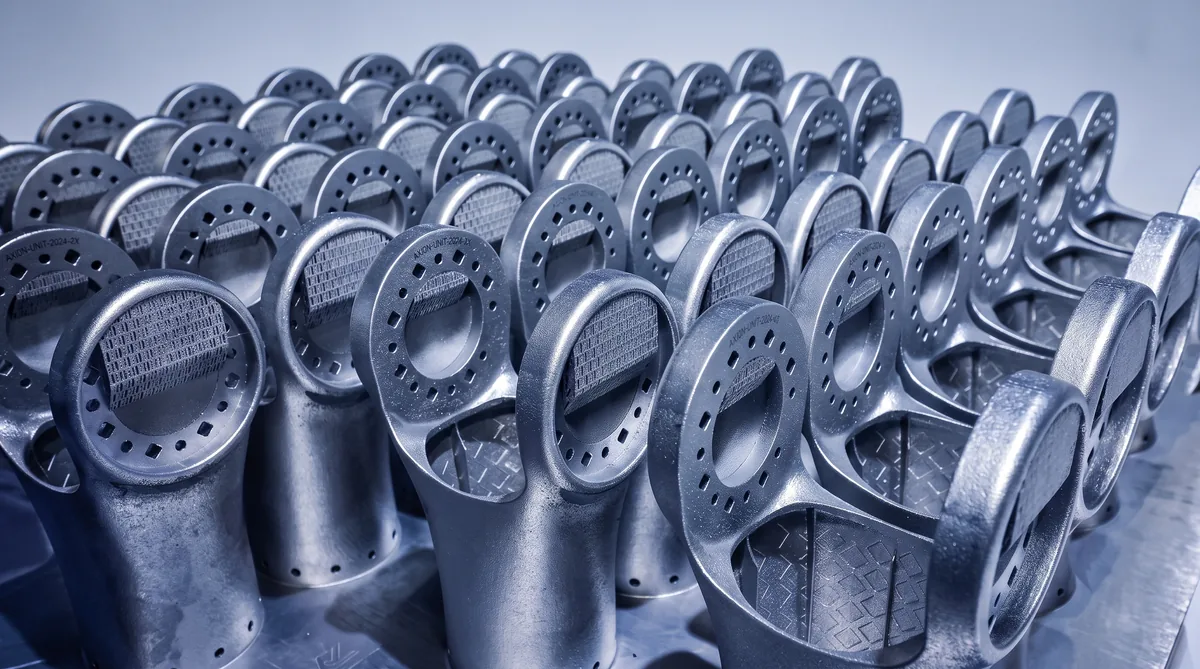
Metal AM‘s real advantage is not “lighter for free.” It is the license to redesign: remove material where stress is near zero, keep stiffness where it is not, and consolidate parts that used to be bolted or welded together.
Materials-first design beats re-machining
A peer-reviewed study on a 75 kg-class humanoid leg optimized the thigh for maximum stiffness and the calf for minimum mass via laser AM, reporting over 50% mass reduction while improving stiffness — with peak FEA stress of 241 MPa, well under yield.[6] Another study fuses the load-bearing frame and the cosmetic skin into a single variable-density-lattice thigh.[7]
| Criterion | Metal AM (LPBF) | CNC machining | Rule of thumb |
|---|---|---|---|
| Part count | many → one | one per material/op | AM wins when integration cuts joints |
| Weight | topology + lattice, −40–85% | limited by tool reach | AM wins on moving limbs |
| Internal channels | printed in one piece | drilled or added | AM wins for cooling/wiring |
| Fine tolerances | ±0.05–0.1 mm typical | ±0.01–0.02 mm | CNC wins; hybrid AM+CNC best |
| Lead time (1 pc) | ~3 days | days–weeks with setup | AM wins for prototype/small batches |
Choosing the material for a robot part
Picking the alloy is the buyer’s real decision. The default rule: AlSi10Mg for large shells, Ti-6Al-4V for high-load links and sensor housings, and never 18Ni300 on moving mass.
| Material | Density | Strength-to-weight | Best robot use | Standard | Watch-out |
|---|---|---|---|---|---|
| Ti-6Al-4V | 4.43 g/cm³ | highest + fatigue | load links, sensor housings | ASTM F2924 | cost, hard to machine |
| AlSi10Mg | 2.67 g/cm³ | good | large lightweight shells | ASTM F3318 | default, below Ti strength |
| 316L | 7.9 g/cm³ | moderate | exposed / clean joints | ASTM F138 | heavy, not light-weighting |
| 18Ni300 (1.2709) | 8.0 g/cm³ | hardest (~2000 MPa) | gripper jaws, tooling | — | too dense for moving mass |
Standards to specify
For any printed robot part, name the standard, not just the alloy: ISO/ASTM 52900:2021 for AM principles and vocabulary,[9] ASTM F2924 for Ti-6Al-4V, ASTM F3318 for AlSi10Mg, and an EN 10204 3.1 material certificate with every shipment. Demand them under a documented ISO 9001 quality system.
What is NOT metal 3D printed — and how to tell
“3D printed” on a robot spec sheet is often polymer or a supplier showcase, not the robot’s metal parts. Being precise here is the difference between a credible article and a debunked one.
Know the limits of the famous models
Tesla Optimus has no verified public metal-AM part. XPeng IRON uses metal printing only for the fingertip bones; its skeleton is die-cast magnesium-aluminum with a carbon-fiber spine, and its “printed lattice muscles” are TPU polymer, not metal. Boston Dynamics’ strong metal-AM documentation (printed Ti/Al legs with embedded actuators and an integrated HPU manifold) belongs to the hydraulic Atlas, not the electric one. Unitree machines use aerospace aluminum and carbon fiber — real, but not confirmed as metal 3D printed. On the record-setting TianGong Ultra, the public, high-confidence metal-AM citation is for its sibling TianGong 3.0, not the Ultra that set the records — the same studio, but keep them separate.
How to evaluate a metal AM supplier for robotics
At 3D Demiurge we run 5 in-house metal AM systems with DfAM engineering, and CNC machining, finishing and inspection under one roof at Zeming under the ISO 9001 quality system. From the shop floor, the checklist for a robot part is:
- Will they redesign for AM, not just re-machine the existing drawing?
- Do they give a 3.1 material certificate per powder batch?
- Is finishing and inspection in-house, or shipped out to a broker?
- Can they show a real robot or similar part, with honest weight-vs-cost numbers?
FAQ
Which humanoid robots use metal 3D printed parts?
TianGong 3.0 uses metal AM for upper-arm, wrist and leg-shell parts, and the supply chain — BLT, Farsoon and Hanbang — supplies metal-AM limbs, hands and force sensors to robot makers. Confirm which model before you repeat a claim.
What is the best metal for 3D printing robot parts?
AlSi10Mg for large lightweight shells, Ti-6Al-4V for high-load links and sensor housings, 316L for exposed joints, and 18Ni300 only for tooling because it is too dense for moving mass.
How much weight can topology optimization save?
Per part, not blanket: up to 40% on a leg shell, about 60% on a titanium hip, and up to 85% on a single small screw. Expect 30–60% on a well-optimized loaded link.
Is metal 3D printing better than CNC for robot parts?
For consolidation, internal channels and weight on moving limbs, yes. For fine tolerances (±0.01 mm), CNC wins. Best is a hybrid: AM the topology-optimized net shape, then machine the datum faces.
Is the record-breaking 2026 Games robot metal 3D printed?
The public metal-AM citation is for TianGong 3.0 from the same studio, not the record-setting TianGong Ultra. The Ultra may share the approach, but there is no confirmed public statement for it.
Conclusion
Metal 3D printing is the manufacturing enabler behind the lightest competition humanoids — the same DfAM, topology optimization and LPBF material playbook that cuts 40–85% per part. Design for it, spec the standard, demand the certificate. Start your engineered quote.
References
- Science and Technology Daily. “完善产业生态 贴合多元场景——机器人发展呈现新趋势.” Republished by 工人日报/中工网. 21 Aug 2026. https://www.workercn.cn/c/2026-08-21/8876037.shtml (accessed 23 Aug 2026).
- CLS (财联社). “BLT explores metal 3D printing for humanoid robot structural parts.” 2026. https://www.cls.cn/detail/xk/40f45f21dd91b0d1f27f97cdaed429eb (accessed 23 Aug 2026).
- Bright Laser Technologies (铂力特). “BLT presents end-to-end metal 3D printing solutions for the humanoid robot industry at RAPID+TCT 2026.” xa-blt.com (accessed 23 Aug 2026).
- Aibang Robotics (艾邦机器人). “Case: Farsoon metal 3D prints a one-piece dexterous hand.” 20 Aug 2026. https://www.aibangbots.com/a/12541 (accessed 23 Aug 2026).
- Aibang Robotics (艾邦机器人). “Case: Hanbang HBD P400 SLM lower-limb structures, −40% mass.” 2026. https://www.aibangbots.com/a/9880 (accessed 23 Aug 2026).
- Jiang, Hongjian et al. “Topology Optimization Design of Humanoid Robot Leg Structures Based on Laser Additive Manufacturing.” Journal of Graphics (JGCM). https://jgcm.ac.cn/en/article/id/e9e57cbf-5784-4e6d-8082-9c14289f6537 (accessed 23 Aug 2026).
- Nie, Gu, Zhang, Jiang. “Lightweight Design and Property Analysis of Humanoid Robot Thigh Integrated Structure with Appearance.” ICIRA 2023, Springer LNCS 14271, pp. 518–528. https://www.springerprofessional.de/en/lightweight-design-and-property-analysis-of-humanoid-robot-thigh/26183310 (accessed 23 Aug 2026).
- CCTV. “第二届世界人形机器人运动会看点与纪录.” 20 Aug 2026. https://news.cctv.com/2026/08/20/ARTI2DqN4MZBKvmNMYHfRVPI260820.shtml (accessed 23 Aug 2026).
- ISO/ASTM 52900:2021, Additive manufacturing — General principles — Fundamentals and vocabulary. ISO. https://www.iso.org/standard/74571.html (accessed 23 Aug 2026).