A microchannel cold plate is the part where AI cooling money is going, and copper 3D printing is the only way to make the good ones. Flagship AI racks now push triple-digit kilowatts per cabinet[3], and conventional machined or skived cold plates have run out of geometry: you cannot mill 0.2 mm channels with manifold-free branching into a solid block. Metal additive manufacturing can — printed flow channels down to 0.15–0.3 mm, heat-exchange area expanded by up to 900%, and cooling performance gains around 48% have been demonstrated on production-intent copper cold plates[1]. Sell-side research now calls 3D-printed microchannel cold plates the key technology of the next liquid-cooling generation[2]. This article covers what a 3D printed heat sink and cold plate can do that subtractive cannot, why copper is both the best material and the hardest to print, and the design and cost rules that decide when AM cooling pays.
Why AI Cooling Hit a Physical Wall
Heat flux is the constraint. Data-centre liquid cooling has moved from room air to rear-door exchangers to direct-to-chip cold plates, and the trend line is one-directional: each GPU generation concentrates more watts into a similar die area. Industry coverage of the 2026 cooling market describes heat dissipation as a hundred-billion-yuan-scale business precisely because conventional approaches are saturating[3].
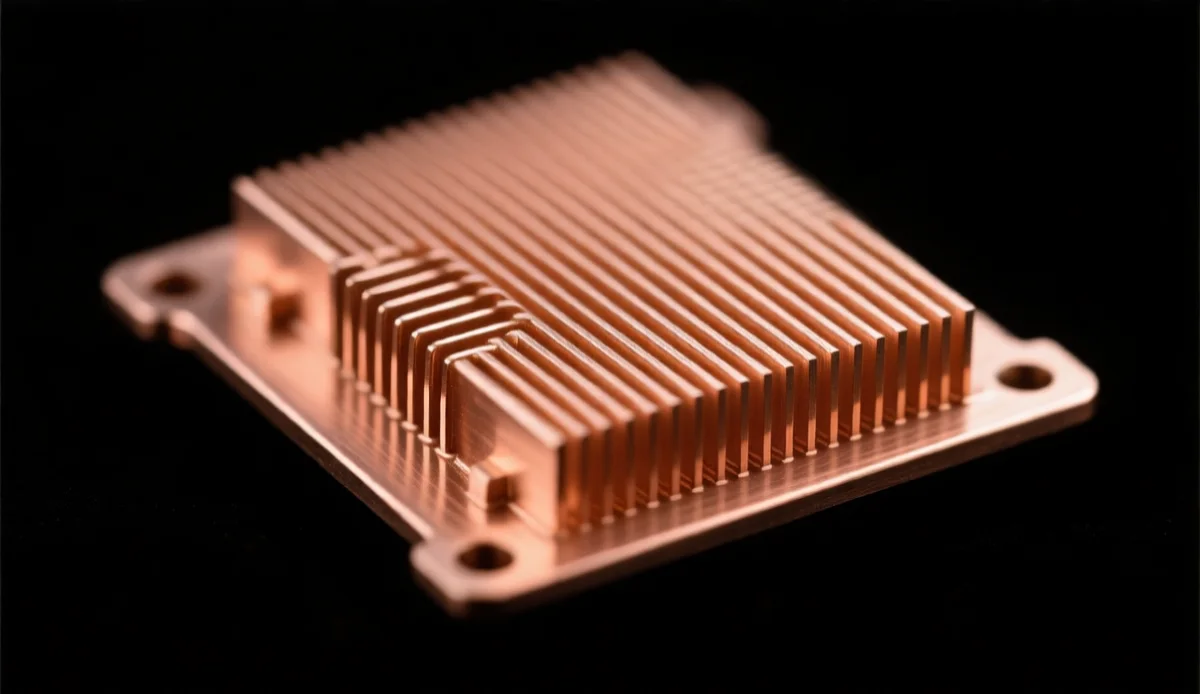
A conventional cold plate is a machined or brazed assembly: a base plate with milled grooves, a lid, fittings, and seals. Its geometry ceiling is set by the tool — end mills cannot cut enclosed channels, aspect ratios beyond ~5:1 are impractical, and every joint is a thermal and reliability liability. Skived fin and micro-groove designs push further, but they are still 2.5-dimensional: uniform channels, no branching graded to the heat map, no internal manifolds.
AM removes the tool. A microchannel cold plate printed in one build can carry channels that follow the die’s hot spots, branch like a vascular system, vary cross-section along their length, and feed from integrated manifolds — no lids, no braze joints, no seals.
What Additive Geometry Actually Buys
The demonstrated numbers from the AI+copper AM work shown at Formnext Shenzhen (August 26–28, 2026) give the scale of the gains[1]:
| Parameter | Conventional cold plate | 3D printed microchannel cold plate |
|---|---|---|
| Minimum channel | ~1 mm milled; ~0.3 mm skived (uniform) | 0.15–0.3 mm printed, free-form |
| Heat-exchange surface | Baseline | Up to +900% area via branching channels, pin arrays, lattices |
| Cooling performance | Baseline | ~+48% demonstrated at equal footprint |
| Structure | Plate + lid + fittings + seals (assembly) | Single printed body, integrated manifolds |
| Channel routing | Straight / serpentine, uniform | Graded to the heat map; variable cross-section |
Three of those rows matter more than the headline numbers. Graded routing sends coolant where the watts are: wider, slower channels over cool zones; dense microchannels under hot spots. Integrated manifolds delete the fitting-to-channel transitions where pressure drops and dry spots form. And single-body construction removes every braze and seal — which is also why the same logic that drives our part-consolidation analysis applies here with unusual force: the assembly was the failure mode, and printing deletes it.

Why Copper — and Why Copper Is Hard
Cold plates live and die on thermal conductivity. The candidate metals:
| Material | Thermal conductivity (W/m·K, typical) | AM status |
|---|---|---|
| Pure copper (Cu) | ~390–400 | Printable but difficult — see below |
| CuCrZr / Cu alloys | ~320–360 | Easier to print; slight conductivity trade |
| AlSi10Mg | ~150–190 | Routine LPBF; half copper’s conductivity |
| 316L stainless | ~14–16 | Routine; structural not thermal |
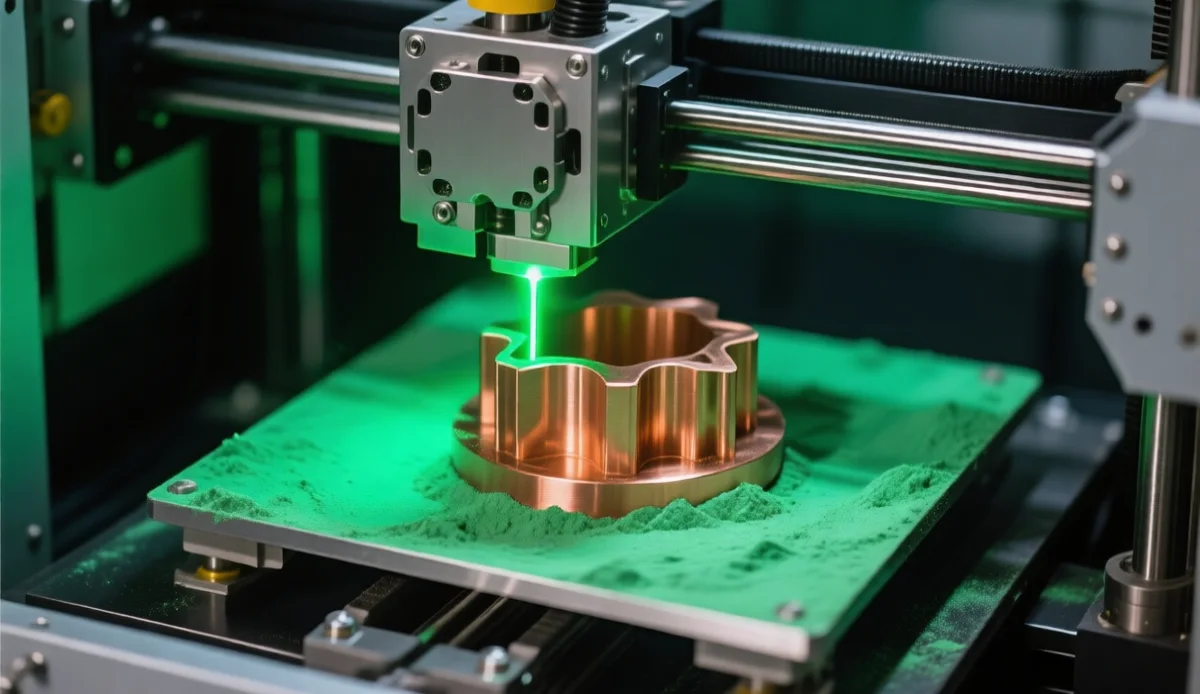
Copper conducts roughly twice what aluminum does — on a die-level hot spot that factor of two is the difference between margin and throttling. The catch: solid copper reflects about 95% of the 1 µm infrared laser light that standard LPBF machines emit, and it conducts heat away from the melt pool almost as fast as the laser delivers it. Printing dense copper on a conventional fiber-laser machine means brute force — very high power, slow scan speeds, hot powder beds — with spatter and lack-of-fusion as constant risks.
Two industry answers have matured. Green lasers (515 nm) are absorbed several times better by copper, enabling stable conduction-mode melting at lower power and high density. High-power infrared with optimized parameter sets reaches ~99.5%+ relative density on pure copper and CuCrZr on modern machines. Either route, copper AM is no longer a lab curiosity — it is a production process with yield curves, which is exactly what the Formnext Shenzhen exhibitors were reporting: AI-driven process optimization lifting yields 10–20% and cutting build-failure rates 30–50% on copper cooling parts[1]. Material selection details for copper and its alloys sit in our materials guide.
3D Printed Heat Sink vs Cold Plate vs Heat Exchanger: The Application Map
The search cluster around “3d printed heat sink” mixes several products; it pays to separate them:
- Cold plates (liquid, closed channel) — the AI-compute case: GPU/ASIC direct-to-chip plates, power-electronics bases, laser-diode bars. Printed copper or CuCrZr, microchannels with integrated manifolds. Highest value density; the +48% performance class of result lives here.
- Air-side heat sinks (open fin) — printed lattice or pin-fin sinks. AM’s edge is topology-free fins, but extrusion and skiving are brutally cheap at volume; printed air sinks win mainly on shape-constrained or integrated applications.
- Heat exchangers (fluid-to-fluid) — the aerospace and process-industry sibling: printed microchannel and compact exchangers in Inconel, stainless, and copper for cryogenic, HVAC, and engine oil duties.
- Conformal / embedded cooling — cooling channels printed directly into mould inserts, chuck bodies, and structural parts — cooling that has no separate “plate” at all. This is where metal AM stops competing with cold plates and creates a category they cannot enter.
Our cooling applications page shows the part classes we build in each bucket.
Design Rules for a Printed Microchannel Cold Plate
Geometry freedom is not geometry anarchy. The rules that separate a good printed cold plate from an expensive paperweight:
- Channel width floor ≈ 0.15–0.3 mm in qualified copper processes[1]; below the process window you get bridging and powder trapping. Design to 0.3–1.0 mm unless the thermal model proves finer is worth the yield risk.
- As-built roughness matters hydraulically. LPBF channel walls come out at roughly Ra 6–15 µm. In laminar microchannels that roughness raises pressure drop; the honest design flow is thermal model → pressure-drop penalty → pump-power budget, not thermal model alone. Surface management options are covered in our post-processing cost guide.
- Self-supporting channels. Round or teardrop channel cross-sections print without internal supports; flat roofs over wide spans do not. This is a DfAM decision made at CAD time, not at the machine.
- Powder evacuation. Every channel must have a clean-out path; trapped powder in a sealed microchannel is a dead part. Design evacuation ports and plan for flush verification.
- Print direction sets the wall. Channel walls built perpendicular to the plate carry different roughness and density than angled ones — orient the build so the thermally critical walls come out best.
The Economics: When a Printed Cold Plate Pays
AM cooling competes against machining and brazing, and the honest comparison is not per-part price at scale — extruded and skived plates will always win commodity volumes. Printed microchannel cold plates pay where:
- Performance is worth money. If 48% more cooling headroom[1] lets a compute node run hotter silicon longer or shrinks the cooling plant, the part premium is rounded away by the system saving.
- The geometry is otherwise impossible. Graded, branching, manifold-integrated channels below 0.5 mm simply do not exist in subtractive form at any price.
- Volumes are low-to-medium or highly customized. No tooling means N=1 economics work: per-node custom plates, prototype thermal architectures, and fast iteration between design cycles.
- Reliability deletes assembly. One printed body with zero braze joints and zero seals removes the dominant leak-failure modes of assembled plates.
The pricing mechanics — per-cm³ build rates, powder, support removal, finishing — follow the same structure as any metal AM job; our pricing guide breaks down each line, and cold plates usually concentrate cost in the copper process premium and post-processing rather than in build volume.
FAQ
What is a microchannel cold plate?
A liquid-cooled plate whose coolant channels are sub-millimetre — typically 0.15–1 mm wide — maximizing wetted surface in a small footprint. Printed microchannel cold plates push channels to 0.15–0.3 mm with free-form routing that machining cannot produce.
Can copper really be 3D printed?
Yes, in production. Pure copper reflects ~95% of standard infrared laser light, so processes use either green (515 nm) lasers with far higher absorption or high-power IR with tuned parameters, reaching ~99.5%+ density. Copper 3D printing services now run cooling parts at series scale.
How much better is a 3D printed cold plate than a machined one?
Documented production-intent results show heat-exchange area up 900% and cooling performance up about 48% at equal footprint, from printed channels of 0.15–0.3 mm with integrated manifolds. Real gains depend on the heat map and coolant loop, so the number to trust is your own thermal simulation.
What materials are used for printed cold plates?
Pure copper for maximum conductivity (~400 W/m·K), CuCrZr where strength and printability matter, and AlSi10Mg (~half copper’s conductivity) for weight-sensitive or cost-sensitive plates. Stainless appears in fluid-to-fluid exchangers more than die-level cold plates.
Is 3D printed heat sink technology ready for data centers?
For direct-to-chip cold plates, yes — that is where the current investment and exhibition activity concentrates, with yield improvements of 10–20% reported on AI-optimized copper processes. For commodity air-side heat sinks, extrusion still owns volume; AM wins on shape-constrained and integrated designs.
What are the limits of printed microchannels?
Powder evacuation (every channel needs a clean-out path), as-built roughness raising pressure drop, and process-yield risk below ~0.2 mm channels. Design reviews should cover all three before the first build.
Can I get a custom cold plate for my hardware?
That is the natural AM use case: send the die heat map, coolant spec, and envelope; the plate is designed around them with no tooling constraints. Low volumes and per-node customization are where printed plates beat every alternative on total cost.
Conclusion: The Cooling Curve Bent, and Metal AM Is on the Inside
AI compute did not invent microchannel cooling — rocket engines have run regeneratively cooled printed channels for a decade — but it made the technology economically urgent at scale, and copper 3D printing matured exactly as the demand arrived. The physics is settled: printed channels reach geometries no mill can touch, and the demonstrated gains (up to +900% area, ~+48% performance[1]) are system-level money, not spec-sheet decoration. If your hardware is running out of thermal headroom, the conversation to have is not “is printed copper exotic” — it is “what does the heat map want the channels to do.” Send that heat map through our RFQ page and get a manufacturable cold-plate design back, with the material and process chosen for your duty, not for the brochure.
References
- NetEase Finance. “叠序宇宙亮相 Formnext 深圳展:AI+铜 3D 打印批量化生产,破解算力散热’物理墙'” (Diexu Universe at Formnext Shenzhen: AI + copper 3D printing for compute cooling). 163.com. Link (accessed September 2, 2026).
- Huafu Securities research summary, via Wogoo. “液冷:AI 算力革命的散热必然选择;3D 打印微通道冷板为下一代液冷关键” (Liquid cooling: the inevitable choice for AI compute; 3D-printed microchannel cold plates as the next generation). wogoo.com. Link (accessed September 2, 2026).
- Toutiao Tech. “AI 算力太’烫’,散热成了千亿级生意” (AI compute runs hot: cooling becomes a hundred-billion-yuan business). toutiao.com. Link (accessed September 2, 2026).