The largest live-fire test of distributed additive manufacturing in history is not a factory program — it is a war. Ukraine’s drone forces print airframes, mounts, and release mechanisms at the front and in distributed workshops, iterating designs in days — the largest live proving ground 3D printed drone parts have ever had; the EU’s May 2026 approval of a €90 billion loan package — €6 billion earmarked for drones — is turning that improvisation into an industrial budget[1]. Meanwhile China’s 3D printer exports rose 119%, a supply-side signal of how thoroughly printing has embedded in drone manufacturing worldwide[2]. This article separates what the war actually proved — mostly polymer FDM at the tactical edge — from where metal AM genuinely enters the drone and defense supply chain, and what both mean for manufacturers positioning into the sector.
What Is Actually Being Printed at the Front
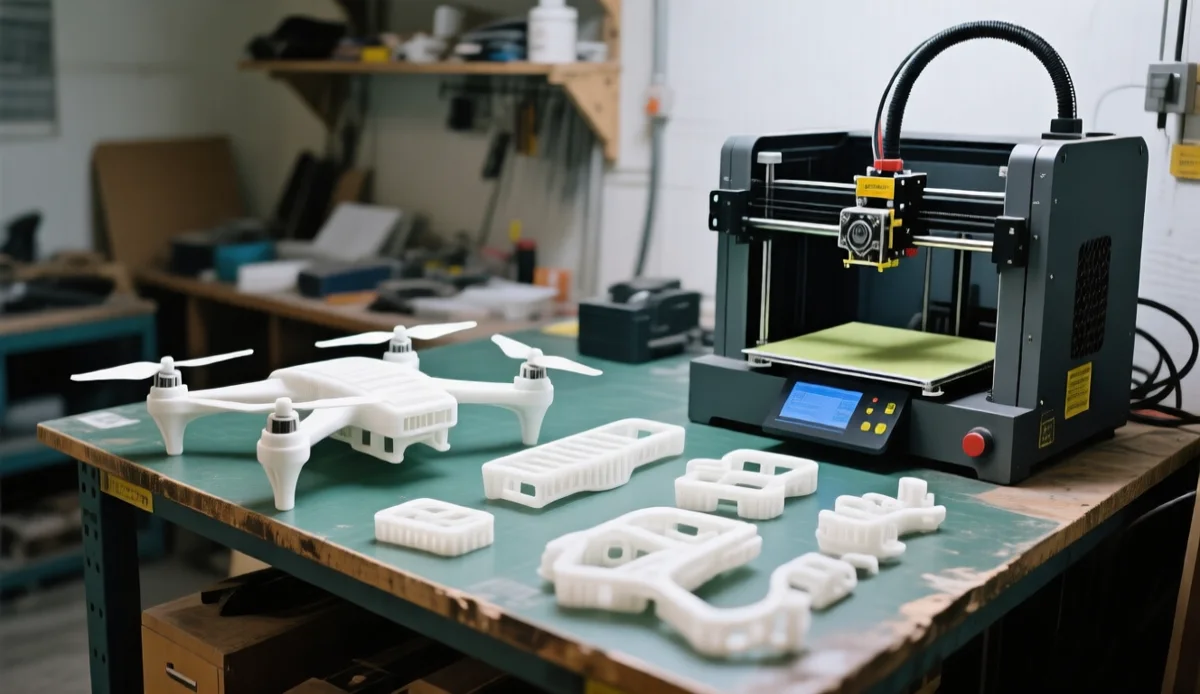
Honesty first, because the hype is loud: the battlefield printing story is overwhelmingly polymer FDM. Reported production covers non-explosive airframe components — wings, fuselage sections, mounts, brackets — printed on farms of FDM machines by units and companies like Wild Hornets, including airframes for interceptor drones such as the Sting[1][2]. The reasons are practical, not ideological:
- FDM printers are cheap, portable, and survive rough logistics. A tent workshop can run dozens of them on generator power.
- Polymer is enough for the job. Small drone airframes at 100–300 km/h live in the strength-to-weight regime where printed PLA/PETG/nylon-carbon composites genuinely compete.
- Iteration is the weapon. Combat feedback loops measured in days mean the design that wins is the one that can be revised overnight — files, not tooling[3].
Anyone selling “metal 3D printed combat drones” as the current picture is overselling. Metal appears at the front mostly as machined or cast motor mounts and fittings. That said — the honest version of the metal story is more interesting commercially, because it lives one level up the supply chain.
Where Metal AM Actually Enters the Drone Chain
The distinction between tactical edge and industrial program is the single most useful lens in this sector, because the two columns buy completely different things: the edge buys printers and filament by the pallet, the program buys qualified metal parts by the drawing. A supplier that confuses the two quotes the wrong product to the wrong buyer.
As drone programs move from workshop batches to funded production — and €6 billion of drone budget is funded production[1] — the parts that carry real load, heat, and wear migrate to metal processes. The map:
| Part class | Tactical edge (10s–100s of units) | Industrial production (1,000s–1M units) |
|---|---|---|
| Airframe shells, wings | Polymer FDM | Injection molding / stamped composites |
| Motor mounts, structural nodes | Machined or printed polymer | Cast or printed aluminum (AlSi10Mg) |
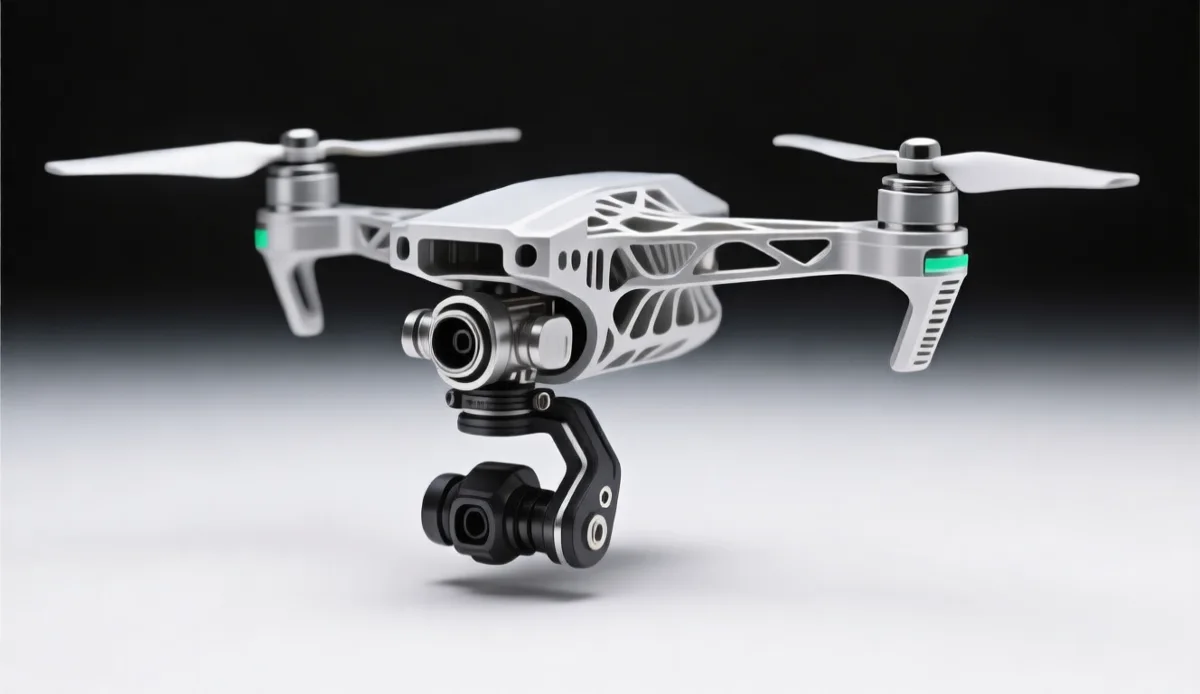
| Gimbals, sensor mounts | Off-the-shelf | Printed aluminum/stainless, topology-lightweighted |
| Release/payload mechanisms | Printed polymer | Printed or machined stainless/17-4PH |
| Interceptor/loitering propulsion parts | Imported assemblies | Metal AM where heat and fatigue govern |
| Ground systems, launch hardware | Improvised | Mixed: printed fixtures + conventional structure |
The right-hand column is where a metal AM supplier lives: not the disposable airframe, but the durable subsystems of funded programs — the same way humanoid robot production concentrates printed metal in joints and hands rather than shells (analyzed in our Optimus V3 ramp article). Material selection follows duty: AlSi10Mg for lightweight nodes, 17-4PH or 316L for mechanisms and wear interfaces — the trade-offs are covered in our 316L vs 17-4PH comparison, and the sector’s part classes on our drone applications page.
What the War Proved — And Why Manufacturers Should Care
Strip the politics and the conflict has validated three manufacturing theses that apply to every industry:
- Distributed production beats concentrated production under stress. Printer farms across many small sites proved more resilient than any single factory could be. The same architecture — many small qualified nodes instead of one big plant — is now a serious strategy for industrial AM capacity.
- Digital inventory is logistics. Sending a file to a front-line printer collapses a supply chain that used to mean factories, depots, trucks, and weeks[1]. Commercially: the same logic runs spare parts for fielded equipment anywhere on earth.
- Iteration speed is a capability, not a convenience. Combat data accumulated over thousands of sorties has driven design generations at a pace no procurement program matches[3]. Companies that structure their AM operations for revision speed — printed tooling, bridge production, fast first articles — inherit that advantage in civilian markets.
The production-scale discipline is identical to what aerospace learned printing a thousand rocket engines: the machine park is easy; powder control, process qualification, and per-lot documentation are the business. Our Rutherford at 1,000 analysis walks that playbook, and the 2026 standards guide covers the certification vocabulary defense supply chains audit against.
The 119% Export Signal
One number deserves attention from anyone in the AM business: China’s 3D printer exports rose 119%[2]. Read it as the market disclosing itself — global drone and defense-adjacent manufacturing is buying print capacity at emergency rates, and the supply is flowing from the world’s machine-production hub. Second-order effects follow the machines: powder and filament demand, spare parts, operator training, and — as programs professionalize — metal systems for the subsystem work described above. For metal AM suppliers, the export wave is a leading indicator of a qualification wave arriving behind it.
The sequence has a readable timeline. Machine exports surge first — capacity gets bought before anyone knows exactly what it will make. Within two to four quarters, consumables and powder follow as machines run. Qualification demand arrives last and stays longest: once programs have hardware, the audits, documentation, and repeatable supply agreements define who keeps the work. Suppliers who wait for the qualification wave to advertise itself will find the vendor lists already written.

Positioning a Metal AM Shop for the Defense-Adjacent Wave
Practical, non-political guidance for manufacturers watching this demand — none of it requires a defense background, all of it requires documentation discipline:
- Sell subsystems, not airframes. The durable-metal share of a funded drone program is motor mounts, gimbals, mechanisms, ground hardware — exactly the complexity-dense, low-to-medium volume class AM wins.
- Get documentation defense-grade before the RFQ arrives. Material certs, lot traceability, first-article reports — the audit expectations are stricter than commercial work and arrive faster than the orders.
- Offer the ramp sequence. Tooling and fixtures first (fast qualification), bridge production second, series parts third — the same sequence the robotics ramp follows.
- Match your tier to the table below before quoting.
| Program tier | What they buy | What they audit | Entry ticket |
|---|---|---|---|
| Tactical / volunteer units | Printers, filament, spare parts | Nothing formal | Speed, logistics |
| National program (funded) | Qualified metal subsystems, tooling | Material certs, first articles | Documentation discipline |
| Allied / export programs | Series parts with traceability | Full QMS, export classification | Certification + legal review |
- Stay on the manufacturing side of the line. The commercial opportunity is durable components and production systems; suppliers of airframe weaponization face export-control regimes that vary by jurisdiction and change fast. Know your classification before quoting.
Common Misconceptions
“Ukraine flies metal 3D printed drones.” The printed tactical components are overwhelmingly polymer FDM — that is the honest story, and it is impressive enough. Metal AM’s war role is in the industrializing programs behind the front, not the airframes over it.
“Wartime printing proves AM replaces factories.” It proves AM absorbs volatility — surges, revisions, broken supply lines. Stable mass production of simple parts still belongs to molding and stamping. The technologies are complements under stress, not substitutes.
“The demand wave is only for printer makers.” Machines are the first order; powder, parts, qualification, and service follow. The suppliers who capture the second wave are the ones building documentation and capacity now.
FAQ
Which 3D printed drone parts are used in the Ukraine war?
Reported production covers non-explosive polymer components: airframe sections, wings, mounts, brackets, and release mechanisms, printed on FDM farms by units and companies like Wild Hornets, including interceptor airframes.
Are metal 3D printed drone parts in combat use?
Metal appears mostly as machined or cast mounts at the tactical edge today. Metal AM enters through funded production programs — motor mounts, gimbals, mechanisms, and propulsion-adjacent parts at industrial scale.
Why does the war favor 3D printing over conventional manufacturing?
Iteration in days instead of months, distributed production that survives disruption, and digital logistics — a file to a front-line printer replaces a factory-depot-truck chain.
What does the EU drone funding mean for manufacturers?
The €6 billion drone allocation inside the €90 billion package (May 2026) converts workshop-scale improvisation into funded series production — where metal subsystems, qualification, and volume capacity become the binding requirements.
Why did China’s 3D printer exports rise 119%?
The reported surge tracks global drone and defense-adjacent manufacturing buying print capacity at emergency rates — a leading indicator for the downstream demand in powder, parts, and services.
Can a small metal AM shop serve this sector?
Yes, via the subsystem route: durable mounts, gimbals, mechanisms, ground hardware, and production tooling — provided material certification and first-article documentation meet defense-adjacent audit levels.
What materials do printed drone subsystems use?
AlSi10Mg aluminum for lightweight structural nodes, 17-4PH or 316L stainless for mechanisms and wear interfaces, with titanium reserved for the highest stress-to-weight duties.
How quickly did printed drone designs iterate during the war?
Reported combat feedback loops ran on the order of days: field results drove design revisions that reached printed hardware within a week — a cadence conventional procurement measures in quarters. That iteration rate, sustained across thousands of sorties, is the war’s most transferable manufacturing lesson.
Conclusion: The War Validated the Method; the Budgets Will Industrialize It
Ukraine proved that distributed additive manufacturing out-iterates, out-survives, and out-logistics conventional supply under stress — with polymer doing the tactical work for most 3D printed drone parts at the front. The €6 billion that now follows that proof will industrialize it, and industrializing drones means metal: printed nodes, gimbals, mechanisms, and the qualified documentation around them. Manufacturers who read the sequence correctly — machine exports first, qualification demand next — position while the window is still open. If your capacity fits the subsystem column of the table above, bring your process list and certification status to our RFQ page; we will tell you plainly which programs your shop can serve today and what it takes to reach the next tier.
References
- Tencent News. “乌克兰 3D 打印战争无人机,已积累大量实战数据” (Ukraine’s 3D printed war drones have accumulated extensive combat data: EU €90bn loan with €6bn for drones; FDM production of non-explosive parts and Sting interceptors). qq.com, May 4, 2026. Link (accessed September 2, 2026).
- Baidu Baijiahao. “乌克兰 3D 打印战场无人机,已积累大量实战经验” (Ukraine’s battlefield 3D printed drones: FDM airframe production, Wild Hornets, China 3D printer exports +119%). Link (accessed September 2, 2026).
- Toutiao Military. “乌克兰 3D 打印战场无人机,已积累大量实战数据” (Combat-data-driven iteration of printed drone designs). toutiao.com, 2026. Link (accessed September 2, 2026).