Technical sources reviewed: .
DMLS, SLM and LPBF are not three guaranteed levels of part quality. In practice they point to the same broad process family — laser powder bed fusion — and DMLS and SLM are commercial names used by specific suppliers, while LPBF is the generic family label. The process name tells you the manufacturing route. It does not specify the material condition, finished dimensions or acceptance evidence of the part you will receive.
When you compare quotations, keep three questions separate: What process is proposed? What exactly will be delivered? How will that delivery be checked? A usable purchase specification answers all three, and the acronym is only the first answer.
Are DMLS, SLM and LPBF the same thing?
In day-to-day buying, yes — they are names for laser-based metal powder bed fusion, with different histories and marketing owners. In a purchase order, no — the names are not interchangeable specifications. A quotation that says only “DMLS” or only “SLM” has not told you the alloy, the heat treatment, the machined surfaces, the inspection method or the documents you will receive.
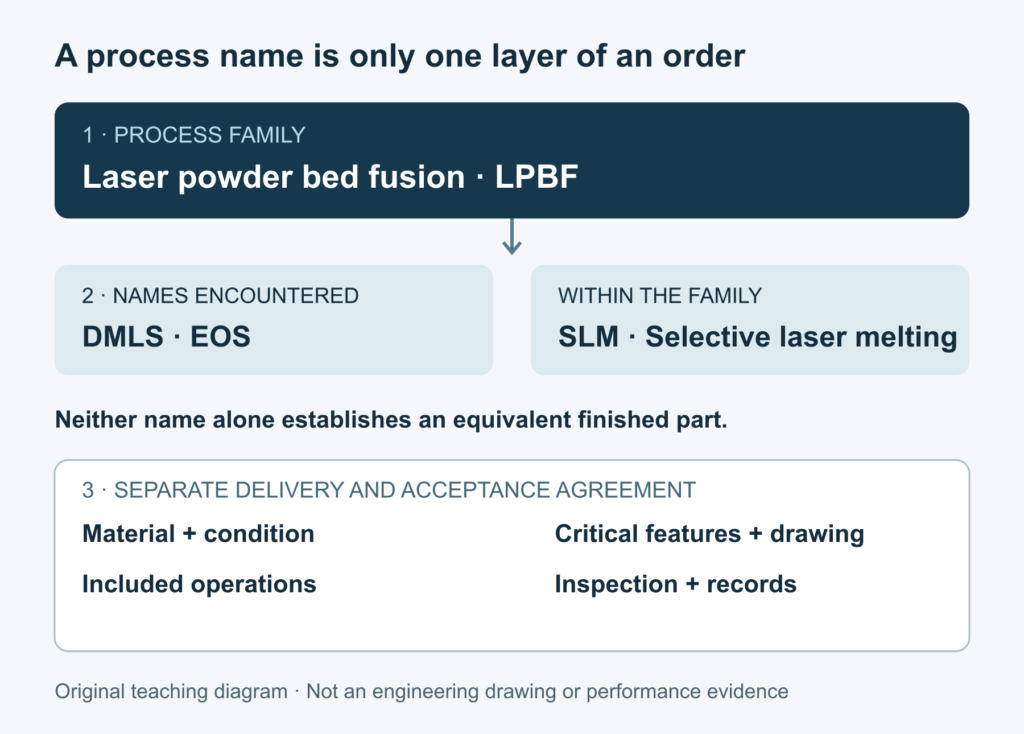
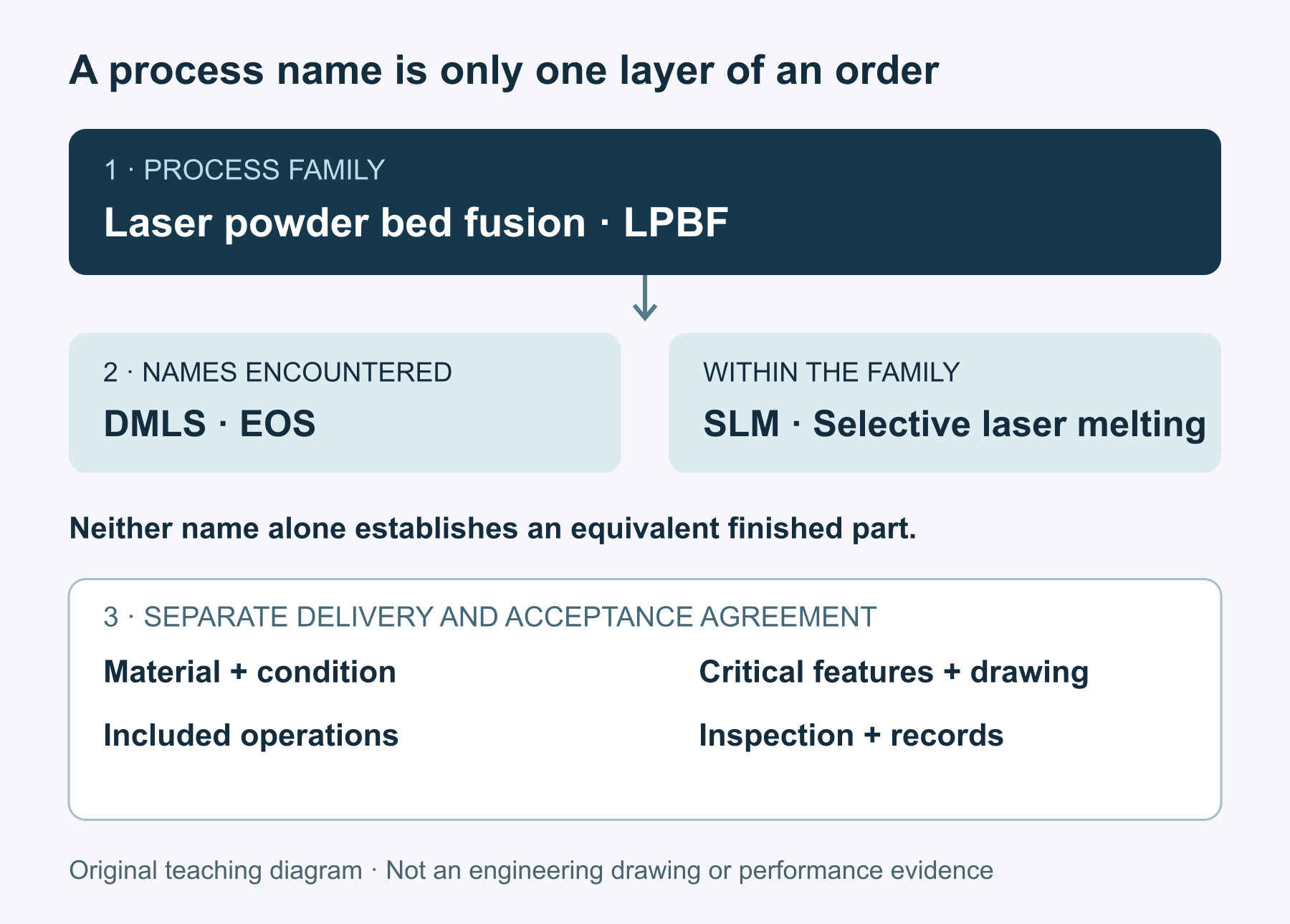
The useful reading is layered. “LPBF” describes the process family. “DMLS” and “SLM” are supplier and brand terminology inside that family. The delivered part is defined by a third layer: your drawing, material specification and acceptance agreement.
Where do the three names come from?
DMLS is an EOS process name. EOS’s current page expands it from the German “Direkt Metall Laser Schmelzen” as “Direct Metal Laser Melting” and describes it as a Laser Powder Bed Fusion (LPBF) technology.[1] The older expansion, “Direct Metal Laser Sintering”, still appears in older documents and in some supplier material — EOS itself used that wording in a 30 September 2021 technical article.[2] That is a terminology change, not necessarily a change in what the machine does.
SLM stands for “selective laser melting” and is used by Nikon SLM Solutions for its laser powder-bed-fusion systems; the SLM®280 system brochure describes the machine as “selective laser melting”.[3] LPBF is the broad family label, and current ASTM standard titles use the shorter “PBF-LB” for laser-beam powder bed fusion of metals[4] — for example in design, qualification and post-processing standards. The terminology itself is defined in ISO/ASTM 52900, the AM fundamentals and vocabulary standard.[8]
DMLS vs SLM vs LPBF: which differences actually affect a purchase?
Most of what differs between quotations is not in the acronym. The table below separates what each label normally refers to from the decisions you still have to make. It is a reading aid for quotations, not a declaration that suppliers or machines are equivalent.
| Purchase question | DMLS | SLM | LPBF / PBF-LB/M |
|---|---|---|---|
| What the label normally means | An EOS process name for laser powder bed fusion; current EOS expansion is “Direct Metal Laser Melting”[1] | “Selective laser melting”, used by Nikon SLM Solutions for its laser PBF systems[3] | The generic family name for laser powder bed fusion; PBF-LB is the short form in current ASTM titles[4] |
| Energy source and build principle | Laser melts metal powder layer by layer at positions defined by the CAD model[1] | Laser-based powder bed fusion on the supplier’s system[3] | Laser-beam powder bed fusion as a family; the label itself does not define the machine |
| Materials commonly quoted | The acronym does not list alloys. Availability is a supplier-portfolio question; the material requirement should name an alloy and its specification, for example ASTM F3184 for UNS S31603 stainless steel.[6] | ||
| Support structures | Any of the three names usually implies a powder-bed build in which the part is supported during printing. Support strategy, orientation and removal are part- and machine-specific decisions to be agreed, not properties of the label.[5] | ||
| What drives resolution and tolerance | Machine, layer thickness, laser spot and scan strategy, build orientation, geometry and post-machining. None of these values is fixed by the process name; they must be stated per feature and per measurement stage. | ||
| Post-processing | Stress relief or heat treatment, support removal and plate separation, machining of interfaces, surface finishing and inspection are separate operations. Which are included changes the delivered part and the price.[5] | ||
| Typical parts | Complex, small-to-medium metal parts such as brackets, housings, impellers and thermal components. The same process family serves aerospace parts and conformal-cooling inserts; their acceptance requirements differ far more than their process names. | ||
| What the term alone does not establish | Delivered material condition, finished dimensions, inspection scope, qualification, supplier capability or a quality level. Those come from the order documents, not the acronym. | ||
Same process family does not mean the same finished part
A quotation stating “LPBF, 316L” still leaves open decisions that change the part: Is it stress-relieved? Which surfaces are machined? Are dimensions measured before or after finishing? What documents ship with it? Protolabs’ metal design guide treats orientation, support placement and post-processing as connected design decisions rather than factory details, and notes that part quality depends on design, materials, machine parameters and secondary processes.[5]
This is why a machine brand matters only when an existing qualification or customer specification requires it. If the brand is not required, removing the brand name from a quote does not remove the need to define and approve the manufacturing route. Two suppliers can both write “SLM” and deliver different heat-treatment states, surface finishes and inspection scopes.
What must a buyer specify beyond the process name?
The purchase specification should define what is being bought, not just how the metal is melted. The table below is a worksheet for the RFQ or purchase order; it is not a reproduction of any standard.
| Specification item | What to state | Why it changes comparability |
|---|---|---|
| Process route and machine restriction | The proposed process family; any machine brand, model or site required by an existing qualification or customer specification; whether the supplier may change the route. | A required machine or site is part of the approved route. An unstated restriction invites an unapproved substitution. |
| Alloy and feedstock | Alloy designation, material specification edition, powder source or lot traceability requirement, and any chemistry or particle-size condition. | “Stainless” or “titanium” is not an alloy. The specification edition and feedstock records decide what the certificate can support. |
| Delivered condition | As-built or heat-treated, stress-relieved, HIP where required, and the condition of each surface. | Heat treatment and HIP change properties and dimensions; an unquoted step is a different part. |
| Post-processing scope | Support removal, plate separation method, machining of interfaces, bores and threads, surface finishing, passivation for stainless steel, and who performs each step. | Two quotes with the same build cost can differ most in the finishing scope. |
| Critical features, datums and measurement state | The datums, fits, threads and surfaces that matter; the inspection method; whether dimensions are measured before or after finishing and heat treatment. | Tolerance without a datum scheme and measurement state is not a requirement you can accept or reject. |
| Inspection and documentation | Dimensional report scope, NDT scope, material certificate, build record, heat-treatment record and certificate of conformity, using ISO/ASTM 52901’s exchange elements as a checklist.[7] | The document package is part of the purchase; availability varies by supplier and part criticality. |
| Orientation and surface requirements | Which faces must be machined, which may remain as-printed, whether support witness marks are acceptable on visible or sealing faces. | Orientation fixes support placement and surface finish; it should be agreed before the build, not inspected after it. |
| Quantity, build sharing and change control | Order quantity, whether a shared build is acceptable, and who approves a process, material or design substitution. | Build sharing and substitutions change traceability; approval rules prevent silent changes. |
Sector expectations also differ. Aerospace programs often add their own qualification and first-article requirements (see aerospace work), while thermal parts such as conformal-cooling inserts are judged on different evidence. The process name is the same family in both cases; the acceptance package is not.
Is one of DMLS, SLM or LPBF better for my part?
No process name is universally better. What matters is whether the proposed route, machine, parameters, orientation, post-processing and inspection can deliver the drawing and the evidence your program needs. If a supplier claims that one acronym gives better tolerances or stronger parts, ask for the data: which machine, which alloy, which build orientation, which specimen and which acceptance standard. A process label is not a test result.
There is also a practical trap in reverse: a customer may insist on “DMLS” when what they actually require is a qualified route and documented material condition. If the requirement is a brand, write it as a brand. If the requirement is a result, write the result.
What can a buyer check without buying the standards?
Standards are paywalled, and this article does not reproduce their requirements. What a buyer can check for free is identity and scope. ISO/ASTM 52900 establishes and defines AM terminology.[8] ISO/ASTM 52901 defines and specifies requirements for purchased AM parts and lists the elements exchanged between customer and part provider at the time of order: order information, part definition data, feedstock requirements, final part characteristics and properties, inspection requirements and acceptance methods.[7] That public scope is enough to build a documentation checklist, but not enough to claim that a part conforms to the standard.
For 316L, the relevant ASTM catalogue entry is F3184-16(2023). Its public scope covers laser- and electron-beam-based full-melt powder bed fusion of UNS S31603 components and notes that they are often post-processed by machining, grinding, EDM and polishing to achieve surface finish and critical dimensions.[6] If a quotation or certificate cites a different designation, ask for the document title and scope rather than assuming equivalence. Citing a standard designation does not replace your drawing, your acceptance agreement or the edition confirmation.
Two quotations that are not yet comparable
Consider a non-load-bearing demonstration bracket. Both quotations say “316L LPBF”. One includes support removal only. The other includes a specified heat treatment, machining of the mounting face and a dimensional report. The identical process label does not make these offers like-for-like.
First ask both suppliers to quote the same drawing revision and delivered condition. Then mark each operation and document as included, excluded or awaiting confirmation. Only after those differences are resolved is a price comparison useful. This example supplies no dimensions, loads or manufacturing parameters and is not a qualified part design.
What to send for an initial discussion
Prepare the model and drawing revision, the alloy and material specification, intended use, quantity, critical dimensions, requested post-processing and the inspection or documentation your program needs. You can send these through the RFQ page and ask for a review of the manufacturing route against a defined delivered condition. For wider context, see the LPBF process overview, the materials and alloys page, the 2026 metal AM standards guide, pricing and the cost breakdown.
Frequently asked questions
Are DMLS and LPBF the same?
DMLS is a supplier process name used by EOS for laser powder bed fusion; LPBF is the generic family name for the same broad process route. For purchasing, treat them as the same family but not as interchangeable specifications — the delivered condition and acceptance evidence still have to be defined.
What is the difference between DMLS and SLM?
Both are commercial names used for laser-based powder bed fusion. DMLS is EOS terminology and SLM is used by Nikon SLM Solutions, among others. The names do not define part quality, tolerance or documentation; compare the proposed delivered part, not the acronym.
Does “sintering” in DMLS mean the powder is not fully melted?
Do not infer the physical mechanism from the acronym alone. EOS currently expands DMLS as “Direct Metal Laser Melting” and earlier used “Direct Metal Laser Sintering”. Ask the supplier to describe the proposed process and material route rather than arguing from the letters.
Is SLM always laser-based?
No single answer covers every supplier that uses the term. “SLM” is a commercial label, so verify the proposed machine and process from the supplier’s documentation. This article describes the laser powder-bed-fusion usage common on metal AM quotations; it does not define every use of the term.
Which process gives better tolerances — DMLS, SLM or LPBF?
No universal ranking exists. Tolerance depends on the machine, layer thickness, scan strategy, geometry, orientation, support strategy and post-machining, plus how and when dimensions are measured. Specify tolerances on critical features and datums and agree the measurement state.
Can I use ISO/ASTM 52900 as my purchase specification?
No. ISO/ASTM 52900 establishes terminology. For purchased parts, ISO/ASTM 52901 is the relevant exchange framework, used together with the alloy’s material specification and your drawing. Standards are paywalled; verify the current edition through the issuing body.
Do these standards promise a specific tolerance or strength?
They define requirements, terminology and acceptance frameworks, not a universal tolerance or property value for every geometry. Specific values must come from your drawing, the quoted material condition, the agreed inspection method and, where needed, test data for the actual build.
Sources
- EOS. “What is DMLS?” Current page expands DMLS as “Direct Metal Laser Melting” and describes it as Laser Powder Bed Fusion (LPBF). Accessed 20 October 2026.
- EOS. “Use-Cases of different Recoater Configurations for Direct Metal Laser Sintering (DMLS)”, 30 September 2021. Accessed 20 October 2026.
- Nikon SLM Solutions. SLM®280 PS system brochure (PDF, 2024). Accessed 20 October 2026.
- ASTM International. Additive manufacturing standards catalogue, where current titles use PBF-LB for laser-beam powder bed fusion. Accessed 20 October 2026; catalogue identity only.
- Protolabs. Additive Manufacturing Design Guide (PDF, DMLS/metal). Accessed 20 October 2026; used as an industry reference for design, orientation, support and post-processing, not as evidence of 3D Demiurge capability.
- ASTM International. F3184 Standard Specification for Additive Manufacturing Stainless Steel Alloy (UNS S31603) with Powder Bed Fusion (F3184-16(2023)). Public scope and title reviewed 20 October 2026; standard text paywalled.
- ASTM International. ISO/ASTM52901 Standard Guide for Additive Manufacturing – General Principles – Requirements for Purchased AM Parts (F3167-17R23). Public scope reviewed 20 October 2026; standard text paywalled.
- ASTM International. ISO/ASTM52900 Additive manufacturing — General principles — Fundamentals and vocabulary (F3177-21). Public scope reviewed 20 October 2026; standard text paywalled.