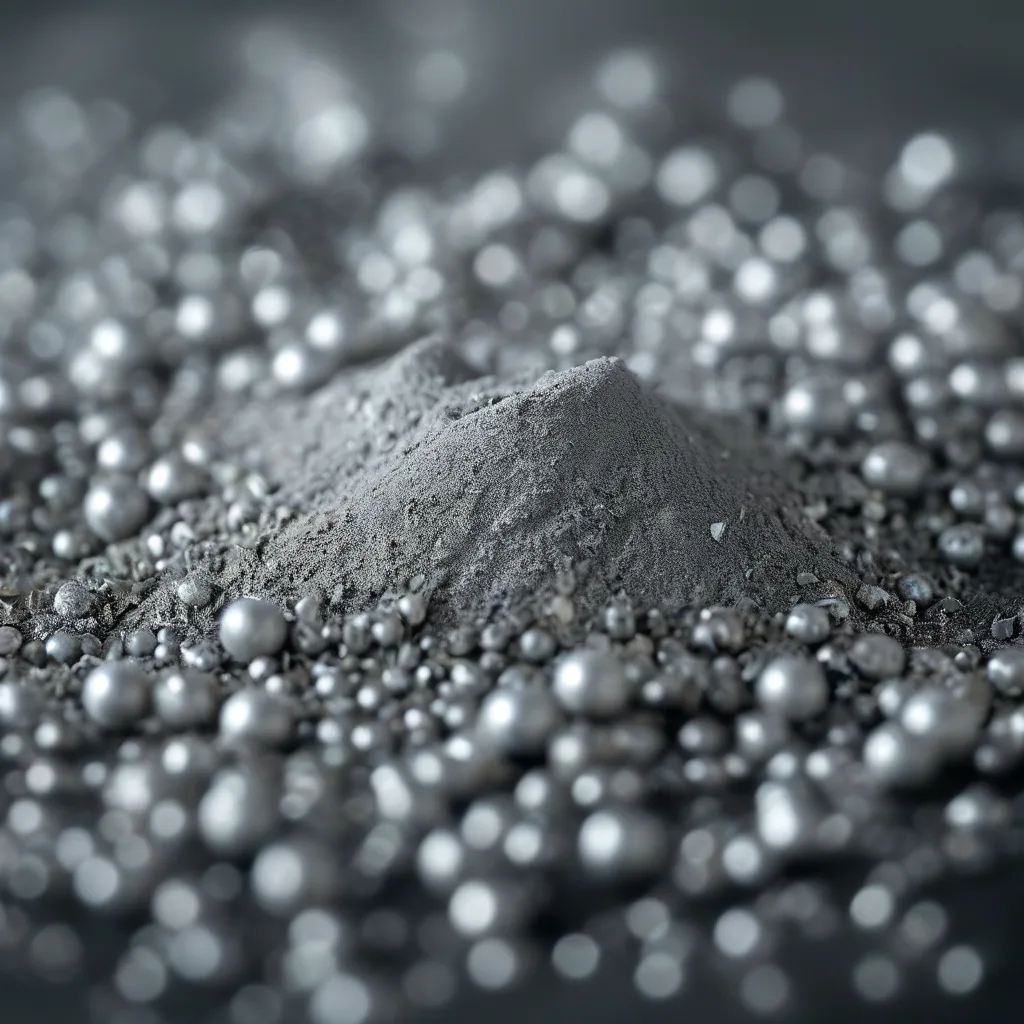
Metal powder is where part quality — and a large share of part cost — is decided before the laser ever fires. For laser powder bed fusion the workhorse spec is a gas-atomized, near-spherical powder screened to roughly 15–45 µm, measured by laser diffraction (ASTM B822), with flow checked by the Hall flowmeter (ASTM B213).[1][5] Here is what each powder property actually does to your part, and what to put on the purchase order.
Why the particle size window is 15–45 µm
LPBF spreads layers 20–60 µm thick, so the powder must be fine enough to form a dense, even layer — and coarse enough to flow. Step outside the window in either direction and a different defect appears:
| Fraction | Share in a 15–45 µm cut | Effect on the build |
|---|---|---|
| Fines < 10 µm | kept low (< ~5–10%) | Oxidize faster, agglomerate, disturb the recoater, feed spatter and balling |
| Core 15–45 µm | the working band | Dense layers, stable melt pool, repeatable spread |
| Coarse > 45 µm | cut off at sieving | Surface roughness, incomplete melting, lack-of-fusion porosity |
A powder certificate should therefore report D10, D50 and D90, not a single “average” — two powders with identical D50 can behave very differently if their tails differ. Datasheets for AM-grade 316L and nickel alloys from atomizers publish exactly these bands.[1]
Sphericity and flow: the properties you can’t see in a datasheet
Gas atomization produces near-spherical particles; plasma and water atomization produce rougher or irregular shapes. Sphericity matters because the recoater blade has ~30–60 µm of clearance to lay a layer: satellites (small particles stuck to large ones) and irregular shapes jam spreading, leave streaks, and show up later as porosity bands. Hall flow rate (ASTM B213, seconds per 50 g) is the quick factory check — a free-flowing 316L typically runs in the mid-teens; a powder that won’t flow through the 2.5 mm orifice at all is a hard reject, not a bargain.
What to require on the powder PO
| Item | Method | Why it matters |
|---|---|---|
| PSD (D10/D50/D90) | Laser diffraction, ASTM B822 | Layer density and surface finish |
| Flow rate | Hall flowmeter, ASTM B213 | Recoating stability |
| Sphericity / satellite count | SEM or image analysis on retained sample | Spreading defects, spatter |
| Oxygen & nitrogen content | Inert gas fusion | Oxidation embrittles; high O/N = degraded mechanicals |
| Chemistry + MTC 3.1 | Mill certificate per batch | Traceability to ASTM/ISO material specs (terminology per ISO/ASTM 52900)[4] |
| Reuse history | Cycle count + sieve record | Properties drift with reuse — see below |
Powder reuse: the honest economics
Unfused powder is sieved and returned to the hopper — that reuse is what keeps LPBF economics sane, since virgin gas-atomized powder is a major slice of material cost. But each cycle adds spatter debris, fines and oxygen pickup, so PSD and flow drift. Studies of reused titanium and stainless powders track property change across dozens of cycles and find well-managed reuse safe within a defined cycle limit — the limit being exactly what a supplier’s sieve/O₂ records should prove.[2][3] When you compare two quotes, ask each supplier their reuse policy in writing: cycle limit, sieve mesh, and whether oxygen is logged per refresh. That single question separates managed feedstock from mystery powder, and it belongs on every RFQ — right next to the geometry, on the quote form.
FAQ
What particle size is used for laser powder bed fusion?
Typically 15–45 µm for LPBF (some machines run 20–63 µm), gas-atomized and near-spherical, measured by laser diffraction per ASTM B822.
Why does powder sphericity matter in metal 3D printing?
Spherical grains flow and spread into dense, even layers. Satellites and irregular particles jam the recoater and turn into streaks, spatter and porosity.
Can reused metal powder still produce good parts?
Yes, within a controlled cycle limit with sieving and oxygen logging between builds; published reuse studies track dozens of cycles with stable properties.[2]
What powder documents should I ask a supplier for?
PSD (D10/D50/D90), Hall flow, chemistry with MTC 3.1, oxygen/nitrogen values, and the reuse/sieve history of the lot being used.[5]
Send your part — the quote states which powder lot builds it →
References
- Carpenter Additive. “PowderRange 316L — Datasheet.” carpenteradditive.com. Link (accessed August 16, 2026).
- Inside Metal Additive Manufacturing. “Powder Reuse in Laser Powder Bed Fusion of Titanium” (white paper, 2024). Link (accessed August 16, 2026).
- Journal of Materials Research and Technology. Powder reuse in LPBF — variability study. 2025. Link (accessed August 16, 2026).
- ISO/ASTM 52900:2021. “Additive manufacturing — General principles — Fundamentals and vocabulary.” Link (accessed August 16, 2026).
- Met3DP. “Metal Powder for LPBF: Complete Buyer’s Guide for 2025.” blog.met3dp.com. Link (accessed August 16, 2026).
- Metal AM. “Metal powders in additive manufacturing: sustainable production, usage and recycling.” metal-am.com. Link (accessed August 16, 2026).