One variable decides it: will the part fail because of its environment, or because of its load? If corrosion kills the part, specify 316L. If stress kills the part, specify 17-4PH. Both stainless steels are the workhorses of laser powder bed fusion (L-PBF, in the ISO/ASTM 52900:2021 vocabulary), both run on the same machines, and both cost a fraction of a titanium or Inconel program. But they end up with nearly opposite mechanical personalities after post-processing — so the wrong choice is a part that rusts in service or yields in service. Here are the numbers, the specs (ASTM F3184 vs ASTM A564), and the five-question checklist we run before quoting any stainless steel AM part.
316L vs 17-4PH at a glance
| Property | 316L (as-printed, stress-relieved) | 17-4PH (as-printed, aged H1025) |
|---|---|---|
| Ultimate tensile strength | 550–600 MPa | 1,070–1,310 MPa |
| 0.2% yield strength | 220–300 MPa | 1,000–1,170 MPa |
| Elongation at break | 40–50% | 8–12% |
| Corrosion resistance (PREN) | ≈ 24–26 (2–3% Mo) | < 20 (negligible Mo) |
| Magnetic response | Essentially non-magnetic | Magnetic (martensitic) |
| Strengthening route | None — stress relief / HIP only | Precipitation aging, H900–H1150 |
| AM material specification | ASTM F3184 | None dedicated — wrought ASTM A564 / AMS 5643; powder AMS 7012 |
| Typical AM parts | Manifolds, chemical & medical hardware | Lugs, brackets, tooling, mold inserts |
Read the table one way: 17-4PH trades ductility and corrosion headroom for roughly four times the yield strength. Every selection rule below follows from that single trade-off.[3]
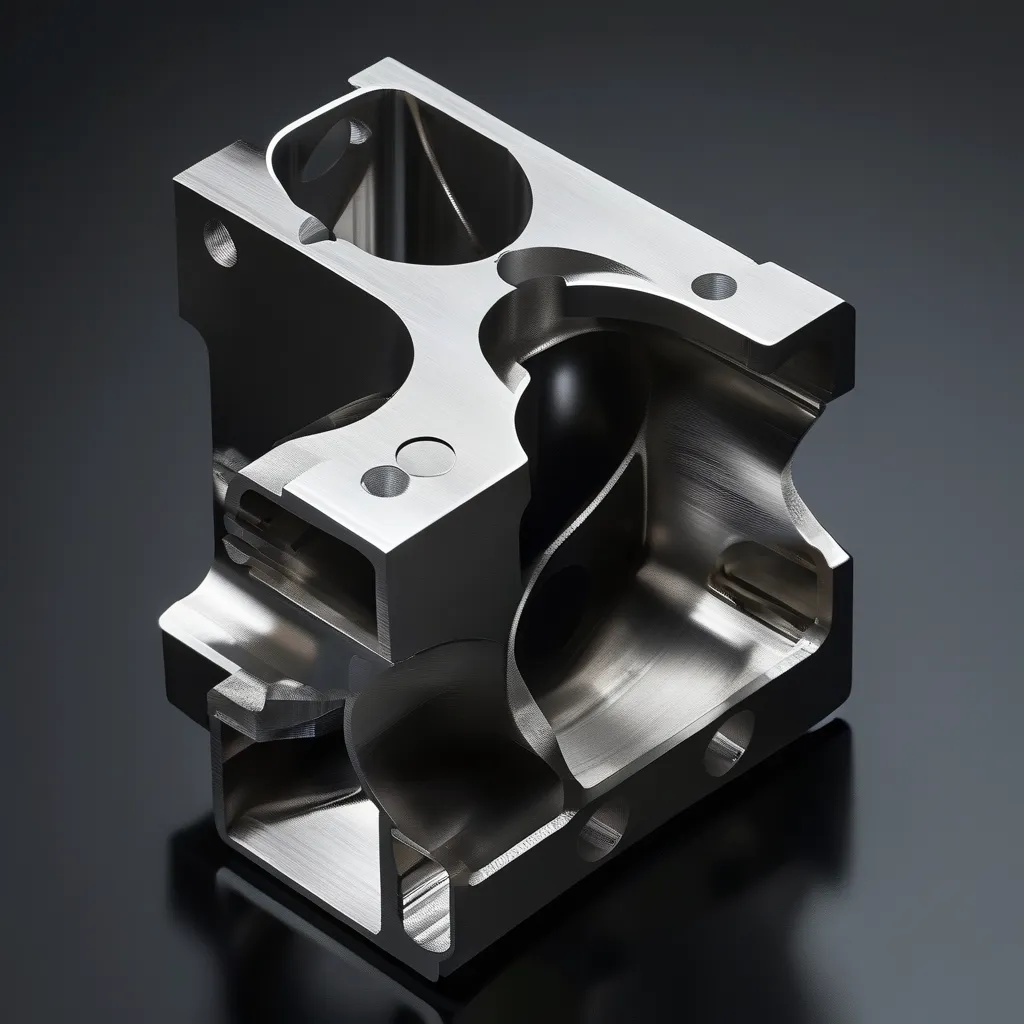
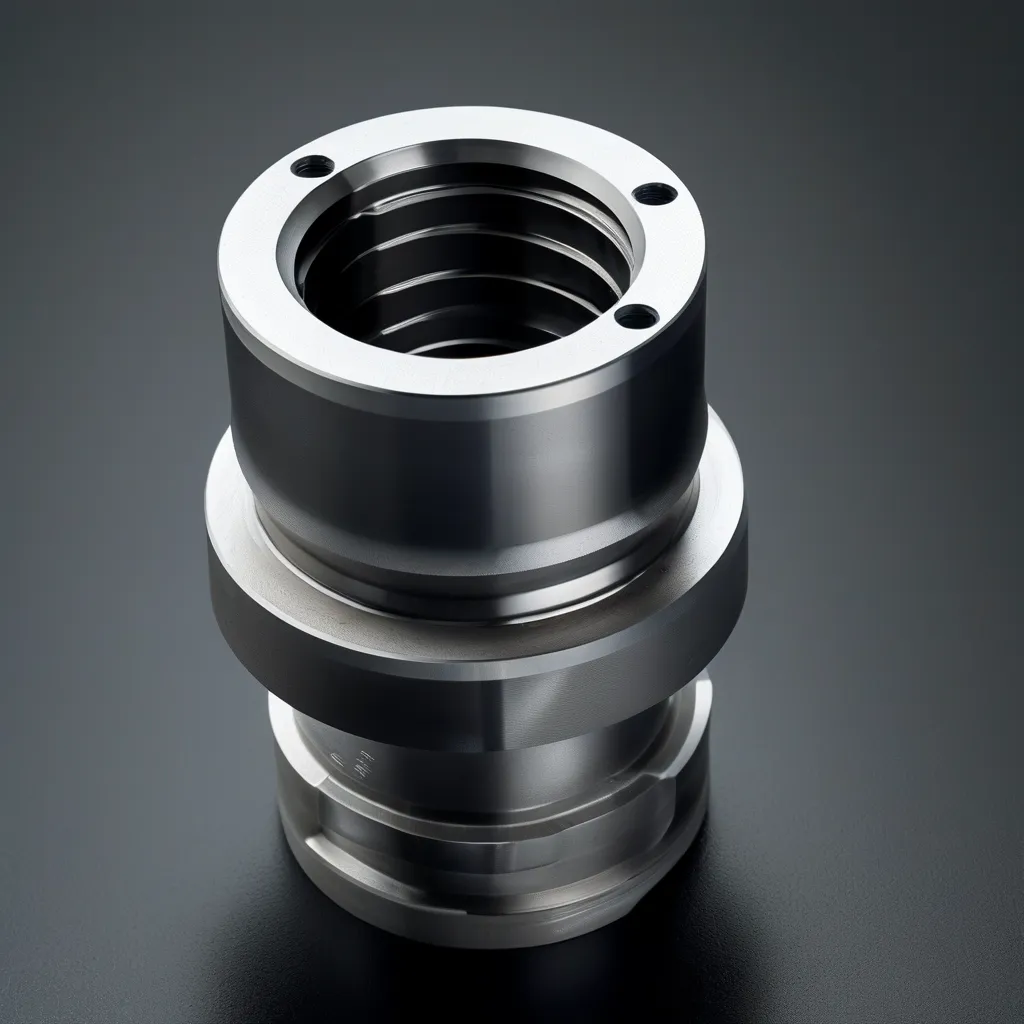
Part photos in this article are illustrative renders of typical L-PBF stainless components; your MTC and first-article inspection carry the real numbers.
When 316L is the right call
- Corrosion is the design driver. Chlorides, seawater spray, wash-down chemicals, body fluids: the 2–3% molybdenum in 316L lifts its pitting resistance (PREN ≈ 24–26) far above anything 17-4PH offers.
- The part must deform without cracking. 40–50% elongation means thin walls, compliant features and impact-prone hardware survive abuse that would chip a hardened 17-4PH edge.
- Non-magnetic behavior matters — sensors, MRI-adjacent tooling, electronic housings. As-printed 316L is essentially non-magnetic; 17-4PH never is.
- You want a clean qualification path. 316L has a dedicated powder-bed-fusion spec, ASTM F3184, with defined minimums (205 MPa yield) and a HIP route in Section 13 for full densification.[1][2] Writing “ASTM F3184” on the drawing removes an entire negotiation.
Typical 316L work we quote: fluid manifolds, food and medical hardware, marine fittings, chemical brackets.
When 17-4PH wins
- Load is the design driver. Condition H900 puts 17-4PH near 1,310 MPa UTS / 1,170 MPa yield — structural hardware at a fraction of titanium’s price.
- Stiff, hard interfaces: tooling, mold inserts, lugs and aerospace brackets that see bearing stresses and wear.
- Strength after moderate heat: aged 17-4PH holds its properties to roughly 300 °C service, where 316L’s low yield becomes the limit.
The honest caveat: 17-4PH has no dedicated additive specification. The industry qualifies it against the wrought spec — ASTM A564 / AMS 5643 — plus a powder spec such as AMS 7012, and states the aging condition on the drawing.[3] If a supplier quotes AM 17-4PH without naming a condition (H900/H1025/H1150), ask what you are actually buying.
Heat treatment: the step that changes the answer
316L and 17-4PH leave the same printer, but they take different roads after it. 316L gets a stress relief at most; its strength is fixed at as-printed values, and hot isostatic pressing — per ASTM F3184 Section 13, around 100 MPa — is the only lever left for density-critical work.[2] 17-4PH is the opposite: as-printed it is not at final strength, and the aging cycle is what creates the properties you paid for. NIST’s work on AM 17-4PH shows post-process heat treatment is precisely what makes the microstructure uniform and reproducible.[4]
| Condition | UTS | Yield | Elongation | Use when |
|---|---|---|---|---|
| H900 (peak age) | ≈ 1,310 MPa | ≈ 1,170 MPa | ≈ 9% | Maximum strength, benign corrosion |
| H1025 (balanced) | ≈ 1,070 MPa | ≈ 1,000 MPa | ≈ 10% | The default engineering compromise |
| H1150 (overaged) | ≈ 965 MPa | ≈ 795 MPa | ≈ 12% | Toughness & corrosion headroom first |
Cost and lead time, honestly
- Powder cost is not the decider. Both alloys sit at the cheap end of metal AM feedstock — a fraction of Ti-6Al-4V or Inconel 718 programs (see our materials table).
- 17-4PH adds one furnace cycle (solution + 1–4 h aging). Real money, small money.
- The true cost drivers are identical for both: support strategy, surface finish, and post-machining — the same economics we break down on the pricing page — and whether printed stainless beats CNC for your part at all is covered in our metal 3D printing vs CNC cost analysis.
- Lead time is a non-issue: both alloys print on our L-PBF line and typically ship in days, not weeks.
The five-question checklist
- What kills the part first — corrosion or load? Environment → 316L. Load → 17-4PH.
- Is there standing water or chloride exposure? Yes → 316L (or better); 17-4PH pits in stagnant seawater.
- Does the part absorb impact or flex? Yes → 316L’s 40–50% elongation.
- What yield strength does the FEA actually demand? Above ~350 MPa → 17-4PH territory.
- Must it be non-magnetic? Yes → 316L, no discussion.
FAQ
Is 17-4PH stronger than 316L?
Yes — roughly four times the yield strength once aged (≈1,000–1,170 MPa vs 220–300 MPa), at the price of ductility: 8–12% elongation instead of 40–50%.[3]
Can 17-4PH be used in marine environments?
Only with care. With negligible molybdenum (PREN < 20) it pits in stagnant seawater; for immersed or splash-zone service, 316L is the floor, not the ceiling.
Does 17-4PH need heat treatment after printing?
Yes. As-printed 17-4PH is not at final properties; it needs solution treatment plus aging (H900–H1150). NIST identifies this step as the key to a uniform, reproducible microstructure.[4]
Can both alloys run on the same machine?
Yes — identical L-PBF platforms. What changes is the parameter set and cross-contamination control between powder lots, which is why we state powder lot and alloy on every quotation.
Which is more expensive to print?
Neither, meaningfully. Feedstock prices are close; 17-4PH adds one aging cycle. Supports, finishing and machining dominate both — see the stage-by-stage pricing breakdown.
Send your part — we’ll quote it in both alloys →
References
- ASTM International. “Standard Specification for Additive Manufacturing Stainless Steel Alloy (UNS S31603) with Powder Bed Fusion, F3184-16 (Reapproved 2023).” store.astm.org. https://store.astm.org/f3184-16r23.html (accessed August 16, 2026).
- Carpenter Additive. “PowderRange® 316L Datasheet (ASTM F3184).” carpenteradditive.com. https://www.carpenteradditive.com/datasheet-powderrange-316l (accessed August 16, 2026).
- MDPI Materials 15(18), 6278. “Strength Properties of 316L and 17-4 PH Stainless Steel Produced with Additive Manufacturing.” 2022. https://www.mdpi.com/1996-1944/15/18/6278 (accessed August 16, 2026).
- NIST. “Additive Manufacturing of 17-4 PH Stainless Steel: Post-Processing Heat Treatment to Achieve Uniform Reproducible Microstructure.” nist.gov. https://www.nist.gov/publications/additive-manufacturing-17-4-ph-stainless-steel-post-processing-heat-treatment-achieve (accessed August 16, 2026).
- Carpenter Additive. “PowderRange® 17-4 AR Datasheet (AMS 7012).” carpenteradditive.com. https://www.carpenteradditive.com/datasheet-powderrange-17-4-ar (accessed August 16, 2026).
- ISO. “ISO/ASTM 52900:2021 — Additive manufacturing, Fundamentals, Vocabulary.” iso.org. https://www.iso.org/standard/74514.html (accessed August 16, 2026).
- Makerverse. “Stainless Steel 316L vs 17-4PH for Functional Prototypes.” makerverse.com. https://www.makerverse.com/resources/stainless-steel-316l-vs-17-4-functional-prototypes/ (accessed August 16, 2026).