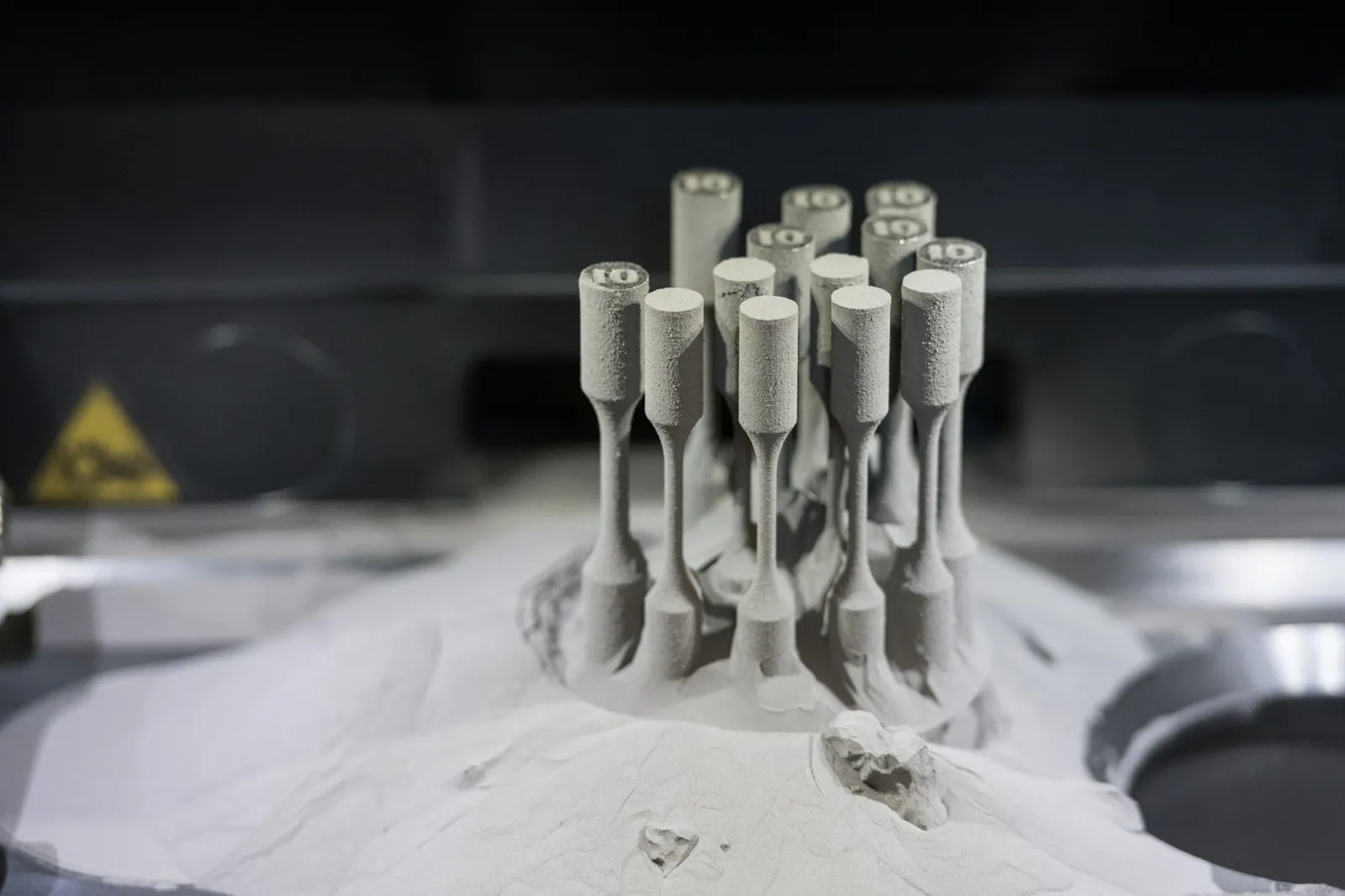
Ten alloys, printed to governing material standards. One verification chain.
Laser Powder Bed Fusion covers a full engineering alloy portfolio — titanium, nickel superalloys, stainless, aluminum, cobalt-chrome, tool steel, and copper. Every part is verified by in-house XRF before finishing. The table below is the reference engineers ask for.
Powder lot, build log, and XRF check — one traceable chain.
Reference Material Properties — Metal AM
Metal AM covers a full engineering alloy portfolio against governing material standards — titanium, nickel superalloys, stainless, aluminum, cobalt-chrome, tool steel, and copper. Values shown are heat-treated per the governing standard.
Typical values for laser powder-bed-fusion parts, heat-treated per the governing standard. Confirm final values against your powder lot certificate and mechanical test data.
Typical printed part · Verified by in-house XRF before finishing
Alloy
Density g/cm³
Yield MPa
Tensile UTS MPa
Elongation %
Hardness
Max Temp
Material standard
Cost
Ti6Al4V Grade 5
4.43
950–1,055
1,050–1,120
13–17
32–38 HRC
~400°C
ASTM F2924
$$$
Ti6Al4V ELI
4.43
~860–930
~910–970
14–18
31–37 HRC
~400°C
ASTM F3001
$$$$
Inconel 718
8.2
~1,180–1,250
1,350–1,450
~20
35–40 HRC
~700°C
AMS 5662
$$$$
Inconel 625
8.4
575–640
880–945
~42
~20 HRC
~980°C
AMS 5596
$$$$
316L Stainless
7.99
490–552
655–703
40–78
88–95 HRB
~870°C
ASTM F3184
$
17-4PH (H900)
7.8
1,170–1,230
1,310–1,370
10–13
40–44 HRC
~315°C
ASTM A564
$$
AlSi10Mg
2.67
200–270
360–460
4–10
~95–115 HB
~250°C
ASTM F3318
$
Cobalt Chrome
8.3
~450–900
~1,255
5–20
40–48 HRC
~800°C
ASTM F3213
$$$
Maraging MS1
8.1
~1,900
~2,000
~12
50–55 HRC
~250°C
1.2709
$$
CuCrZr
8.9
200–450*
350–600*
8–15*
80–120 HB*
~350°C
AMS 5221
$$$$
* CuCrZr properties depend on heat-treatment state. Values are reference ranges, not guarantees — verify against powder-lot certificate and test data.
Ti6Al4V is the most common metal AM material — strong, corrosion-resistant, biocompatible, and printed to full ASTM standards. ELI (Grade 23) trades a little strength for higher toughness and fatigue life, specified for implants.
Nickel Superalloys — Inconel 718 & 625
Where it gets hot.
Inconel 718 powder · AMS 5662
718 max temp~700°C
625 max temp~980°C
718 heat treatmentSolution + double age (required)
625 heat treatmentNone required
StandardsAMS 5662 / AMS 5596
Typical useTurbine housings, high-temp structural, oil & gas
Inconel 718 needs a full solution + double-age cycle to reach 1,350–1,450 MPa UTS — the strongest high-temperature option. Inconel 625 needs no aging, delivers ~42% elongation as-built, and holds up to ~980°C.
316L is the budget corrosion workhorse with excellent ductility. 17-4PH is the precipitation-hardening stainless — aerospace-grade strength after H900 aging.
Maraging MS1 is the mold steel — simple aging reaches ~2,000 MPa, making it the conformal-cooling insert standard. CuCrZr brings copper's thermal conductivity into a printable alloy, enabling copper-in-steel hybrid tooling.
Not sure which alloy fits your application? The DfAM review (included, no charge) recommends a material based on your loads, environment, and volume.
Titanium buys the highest strength per kilogram; IN718 keeps most of its strength above 650°C where stainless and aluminum give up. Typical as-printed + heat-treated values.
Materials FAQ
Which alloys can you produce?
Ten alloys: Ti6Al4V Grade 5 (ASTM F2924), Ti6Al4V ELI (F3001), Inconel 718 (AMS 5662), Inconel 625 (AMS 5596), 316L (F3184), 17-4PH (UNS S17400 / ASTM A564), AlSi10Mg (F3318), Cobalt Chrome (F3213), maraging MS1 (1.2709), and CuCrZr (AMS 5221). All verified by in-house XRF before finishing.
Which alloy should I choose for my application?
Select by your constraint: lightest + strong → Ti6Al4V; medical implant → Ti6Al4V ELI or CoCr; high temperature ~700°C → Inconel 718; corrosion + budget → 316L; stainless high-strength → 17-4PH; lightest + moderate → AlSi10Mg; wear/dental → CoCr; conformal mold → MS1; thermal conductivity → CuCrZr. Our DfAM review recommends a material from your loads, environment, and volume.
Is the material certified?
Yes. Every powder lot arrives with a mill certificate. Zeming issues EN 10204 3.1 for the finished part as the producing facility. We compile both, plus XRF verification data, into your traceability package.
How do you verify the material is correct?
In-house X-ray fluorescence (XRF) analysis. Every part is tested before any finishing work begins, and the result is matched against the powder lot certificate and the specified alloy.
Can you print pure copper?
Pure copper is difficult to process with standard L-PBF lasers. We offer CuCrZr (copper-chromium-zirconium) on request. For pure-copper applications, discuss it with us — current availability is confirmed with your quotation.